In the Introduction to Pope Leo XIV’s encyclical Magnifica Humanitas, the pope states that magnificent humanity today faces a crucial choice: to decide whether to build a new Babel or to rebuild the walls of Jerusalem, as Nehemiah did after the exile in Babylon. The conscience of every person of our time is challenged by questions that can no longer be avoided: “Where are we going? Toward what goal do we wish to direct ourselves? Which direction should we choose as a human community and as peoples?” * It is time for communal discernment that leads to a profound understanding of the signs of the times, in order to respond to the epochal challenges that have already emerged on the horizon. The biblical icons presented to us by “Magnifica Humanitas” are precious guides for a journey of personal and communal deepening.
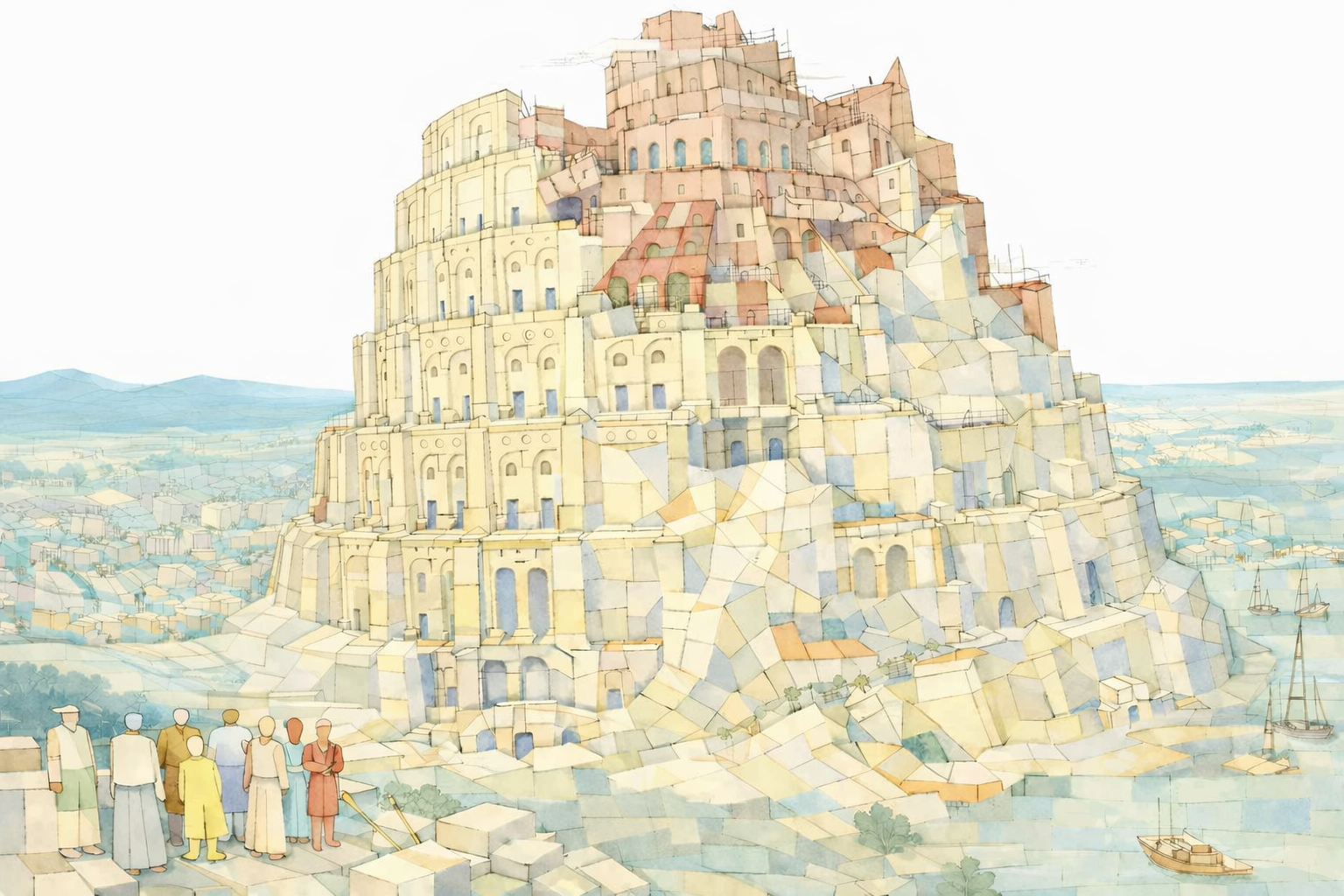
The Book of Genesis (chapter 11, verses 1–9) recounts how, after the Flood, people resolved to build a tower in Babel, in the plain of Shinar, so high that it would reach the heavens, thereby making a name for themselves so as not to be scattered across the earth. God did not bless this project and confused the languages of humankind; no longer able to communicate, they were unable to complete the tower’s construction and scattered, unhappy and alone. “Babel” has become a paradigm of incommunicability among people, of confusion, of dispersion, and of hubris—the arrogance and pride of humanity that feels detached from any reference to God, master of the world and lover of a self-determined power ready to violate every civil rule and every right.
From the encyclical, we can reflect on certain key issues that may point to humanity’s potential drift toward a new Babel. The development of technology—with advances in robotics, AI, and widespread digitization—should not be viewed with suspicion, but its pervasive impact and its power to shape and influence society must be carefully considered. “In the past, it was primarily states that guided and directed innovation. Today, however, the main drivers of development are private actors—often transnational—endowed with resources and capacity for action that surpass those of many governments. Technological power thus takes on a new, predominantly ‘private’ face, and for this reason is even more difficult to discern, govern, and direct toward the common good.”1
Today, the temptation to pursue human development that excludes God returns with a “technical face,” Leo XIV identifies the “Tower of Babel syndrome” as manifesting in the “idolatry of profit that sacrifices the weak,” in the “uniformity that erases differences,” and in “the claim of a single language—including digital language—capable of translating everything, even the mystery of the person, into data and performance metrics.” The “Babel syndrome” could be seen in the disintegrated social fabric, “individualistic globalization,” the “rehabilitation of war as an instrument of international politics,” and the “polarized narratives” amplified by algorithms to foster divisions and conflicts.
Faced with the danger of losing one’s way and of dehumanization, the Christian looks to God made Man, rediscovers the Way and hope, and begins anew to build the walls of the city in which to live justly in the truth and love of God and one’s brothers and sisters.
The encyclical presents us with Nehemiah who, after learning that Jerusalem had been destroyed, its gates consumed by fire, the walls laid waste, and those who had escaped deportation were living in the city in wretched and suffering conditions, decided—after praying and fasting—to ask God to bless his plan to rebuild the walls of Jerusalem, to bring the people back to observing the Lord’s commands, to fear His Name, and to believe in His promises.
The city was rebuilt through everyone’s commitment; God blessed them and strengthened the bonds among the people. “Ancient Jerusalem thus rediscovers a common language—not one of uniformity, but of communion: the harmony that arises when each person takes on their share of the work and the entire people recognize that their strength comes from the Lord.”*
By reflecting on the figure of the Jew Nehemiah, we can choose to build a world in which technological progress becomes the driving force behind development that safeguards the rights of all, rejects the throwaway culture, is inclusive, and offers everyone the opportunity to live free from poverty and new forms of slavery. In the Social Doctrine of the Church, analyzed diachronically with reference to the social encyclicals from Leo XIII’s Rerum Novarum to Pope Francis’s Laudato si’, the encyclical Magnifica Humanitas points to the foundation of a reality in constant dialogue with history and with various cultures, capable of responding to the challenges of the most advanced sciences and technologies—including AI—within the horizon of the Truth that transcends time and draws all things back to itself.
Returning to the figure of Nehemiah, the Pope states: “In him I recognize a luminous parable of our vocation to be, in this age of digital transformation, not resigned spectators of social and cultural fractures, not mere commentators on the ruins, but women and men who enter the building sites of history—research laboratories, technology companies, schools, the media, institutions, and local communities—to rebuild what has collapsed and protect what is exposed.”
“Rooted in Christ,” we can commit ourselves to building a more just and more humane world.
“I praise with an intoxicated voice because I see no imperfection in the universe
I see no cause or result that, in the end, is evil.
And to the recurring question: ‘What good is there in all this?’
The answer is: That you are here, that life exists, that you are alive,
that the mighty spectacle continues
and you can contribute a verse.”
(Walt Whitman) .2
How to cite this article
Cristina Scorrano. (2026, June 18). A Decisive Choosing for Humanity. Rielo Institute for Integral Development. https://riidblog.org/post/18-06-2026/