According to Pavel Florensky1, the “fundamental difficulty” of ancient metaphysics lies in how to reconcile unity with multiplicity.
Applied to the field of politics, this means figuring out how to integrate the unity of a nation, an institution, or a people with the multiplicity and pluralism of the differences that are part of it—namely, citizens, intermediate institutions, ethnic groups, and minorities.
A major transformation has taken place: for Plotinus, the One preceded being in ontological dignity. For postmodernists, all reality is an infinite difference where richness consists in not participating in a universal—that is, in nothing that is common to all.
In politics, when unity prevailed over multiplicity, there was the triumph of the sovereign’s absolutism. In the post-humanist era, however, there is a sort of fever that seeks to make difference prevail over unity. It seems that only diversity and multiplicity are good, and that every form of unity is therefore a constraint and an obligation—and thus the original sin of politics.
Significant is the possibility of the existence of multiple genders (bisexual, pansexual, asexual, demisexual, polysexual, genderqueer…). Or, in the field of ethnology, the “woke” exaltation of minority communities, whereby the value of being different becomes absolute. This is the new tribalism discussed by Susan Neiman 2
The proliferation of genders, hybridization with animals, and transhumanism are expressions of the triumph of individualism and the rejection of what is universal.
In the field of biology, however, the infinite differences among the cells that make up a living organism coexist with a close complementarity. Thus, each cell operates in a coordinated manner toward a common goal. Only in cancer is this relationship broken. There, cancer cells are independent of any subordination to the organism of which they are a part. This independence, however, results in the death of the individual and, with it, that of the cancer cells. On the other hand, since healthy cells are coordinated toward a unified purpose, they limit their degree of freedom to only what is useful for the organism
The problem of unity within multiplicity appears insoluble.
Rousseau sought a solution to the problem of how to integrate the free wills of citizens with the public good without this in any way limiting personal freedom, which Rousseau viewed as an absolute.
Unfortunately, we know that the solution he proposed in his Social Contract was illusory, mythological, and unreal. A solution that, in turn, created many victims at the hands of various followers of the Swiss philosopher.
With another solution, the liberals sought to integrate social unity into the multiplicity of individual wills through the concept of private interest and exchange: if everyone pursues their own interests, we will all be richer and freer.
This may work in the economic sphere, but human beings are not merely economic entities, and when they concern themselves solely with their commercial dimension, they become alienated. It is no coincidence that the great critique of modernity directed at consumerist society highlights the madness of a social space limited solely to exchange and consumption.
The contemporary posthumanist loves difference and plurality. He is the son of Proteus, the god who could transform himself into anything, the master of difference.
The posthumanist shudders with revulsion at any universalistic position. Only difference is good; only unity is bad because it is antithetical to the former.
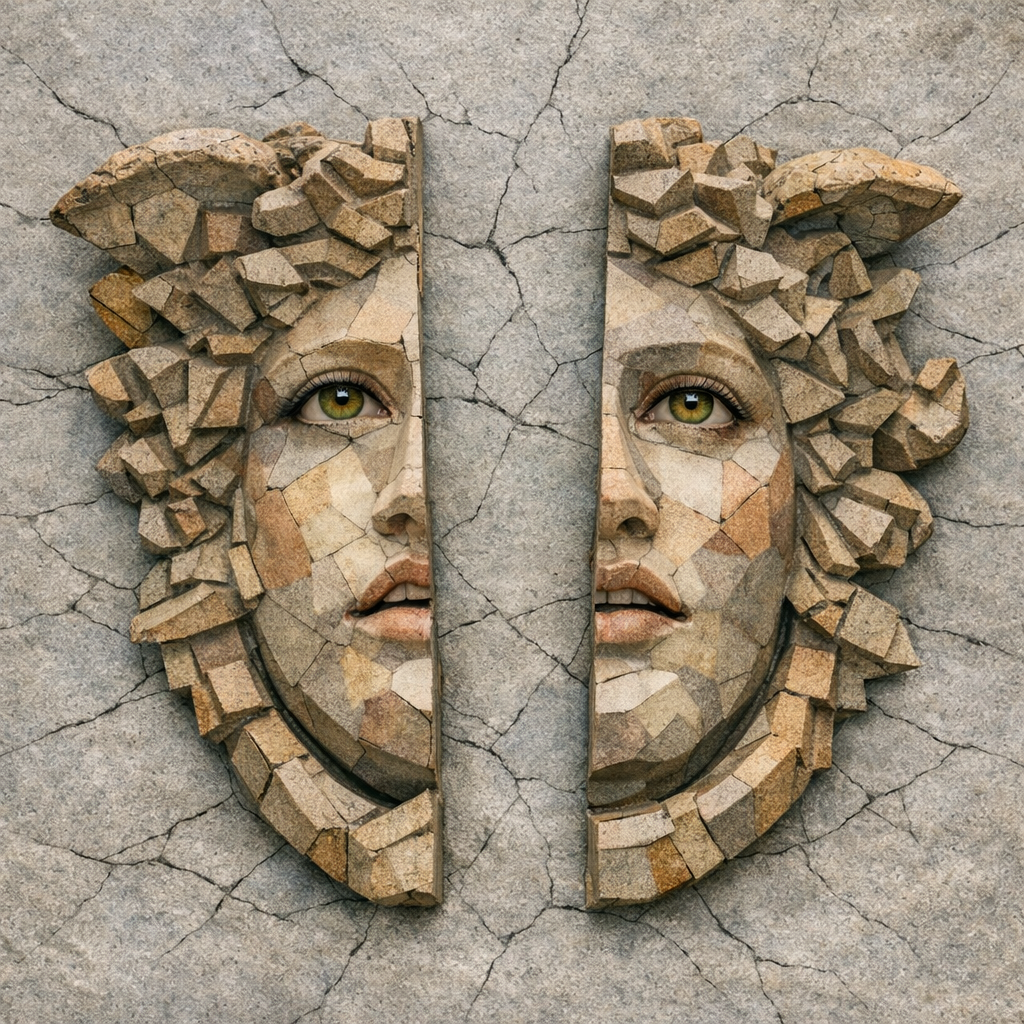
Even truth is seen as a danger and a monster whose head must be cut off. For if there is only one truth, then it is coercive; it compels obedience. On the other hand, if truth is manifold, tied to the individual’s taste, then contradictory judgments are possible in which the true and the false will have the same value. But for postmodernity, the false does not exist. Everything is true; each is a relative expression of the individual’s difference.
Any concept that unites—gender, homeland, family, friendship—is rejected outright.
But in doing so, something unexpected happens, an unpredictable result: the individual who, while following their own private path, believed themselves to be free, finds themselves in the end alone and without connections.
With a distinct identity, in a single body with independent thought and a desire of their own, one becomes what is called “idioglossia” in linguistics—those invented languages that are incomprehensible to the rest of the community because they are not part of shared lexicons or syntax. They remain mere incomprehensible sounds.
Thus, sadly as the sun sets, the man-of-multiplicity sets out to become a human idiolect—sharing nothing and uniting with nothing,
On the other hand, the posthumanists suggest that only by destroying the universal “man” can one be truly free. There can be no orders or taxonomies, but only cartographies and rhizomes in the jargon of Deleuze and Guattari3. Freedom can only come through difference.
But is it really worth losing all relationality, all communal connection, in the name of absolute freedom? Is freedom really that important? So powerful that it destroys life itself? Is freedom the absolute value? Perhaps not.
Perhaps, just as we have lived for so many millennia, we need relationships and sharing—to participate in one another’s lives. Perhaps the exaltation of freedom as an absolute value was an event that stemmed from a tyrannical absolutism: To overcome slavery, it was necessary to fight for freedom.
But in modern times, something more subtle has occurred: we have shifted from the concept of liberation from slavery to that of an ideologization of freedom—a true totem, an immovable fetish—that replaces God and leaves us in the most utter solitude. Without fathers, without family, without a community.
Why so much pain? Could it be that we must reduce freedom from a fetish to that of a simple virtue—important, but not absolute?
The fact is that we owe it to one another. All of us. As Fernando Rielo would say, our fullness, our very existence, our ontological constitution lies in our relationship with the other: "[Man] knows he is someone because he is conscious of someone who, being present in his consciousness, in turn makes him someone." 4. This means that our freedom can only lie in a relationship that is neither one of subjugation nor of domination, but of essential complementarity—
Florenskij, P. A. (2012). Il significato dell’idealismo: La metafisica del genere e dello sguardo (N. Valentini, Ed.; R. Zugan, Trad.). SE. ↩︎
Neiman, S. (2024). Left is not woke (Expanded and updated edition). Polity. ↩︎
Deleuze, G., & Guattari, F. (1987). A Thousand Plateaus: Capitalism and Schizophrenia. University of Minnesota Press. ↩︎
Rielo, F., & López Sevillano, J. M. (2025). Consciousness, Neurosis, and Their Therapy. Editorial Dykinson. ↩︎
How to cite this article
Riccardo Colasanti MD. (2026, July 5). The Freedom That Kills. Rielo Institute for Integral Development. https://riidblog.org/post/05-07-2026/