An article published on April 13, 2026, in FQ Magazine by Il Fatto Quotidiano tells the story of Katie, a 32-year-old former human resources employee at a company who, according to her own account, overcame postpartum depression by using AI and entrusting the algorithm with complete control over her life. “I described my dream life to the AI, and now I always follow its orders. I don’t trust myself; ChatGPT even decides whether I should wash my hair.” The number of people downloading apps capable of creating custom chatbots—structured with specific data to act as confidants, coaches, and virtual friends—is growing exponentially, especially in the Western world. “AI Companions” offer comfort; they do not judge, do not contradict, remember everything, are charming, usually have a harmonious and gentle tone of voice, and create a “relational bubble” that makes people feel good, accepted, and understood. Young people are increasingly trusting chatbots, making requests that span the most diverse fields: from ethics to medicine to spirituality. The major digital platforms are seeking experts in moral philosophy, anthropology, and theology to provide ethical and wisdom-based information to the algorithms. In virtual relationships, empathy is not necessary, nor is the effort to listen to the other. These interactions between humans and AI using GPT (Generative Pre-Trained Transformer), capable of generating text similar to human speech, raise at least two pressing questions: the definition of the person in their essence and in their distinction from AI, and the evolution of human language in the computational age.
The issue of language in the digital age was addressed in Paolo Benanti’s text “Is Man an Algorithm?”. The author asks: “To what extent and in what way does this form of computed language ‘participate’ in human language? How and to what extent is it capable of mapping reality and contributing to the creation of our world?” The neural network (Transformer) with which ChatGPT is equipped enables it not only to process vast amounts of data but also to handle grammatical and syntactic rules; however, as Benanti states, “GPT’s semantic understanding is limited: the model has no intentionality or consciousness, meaning it does not truly understand what it is saying. It mimics human language based on statistical correlations between words in the training data.” Furthermore, no digital assistant can be capable of giving “meaning” to words. “Meaning” is tied to a person’s culture, their value system, their life experiences, and the interpretation—always subjective—that a given word evokes.
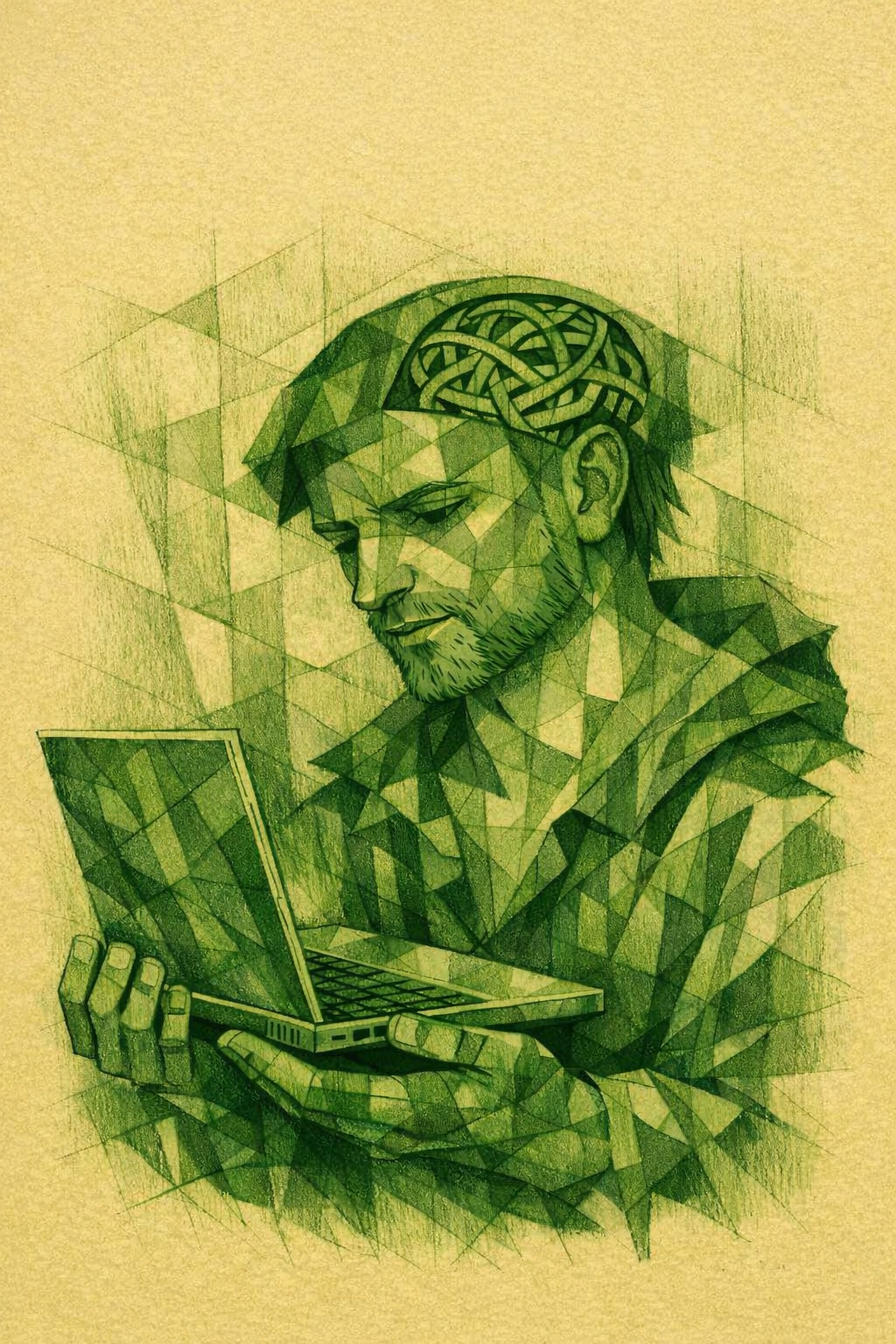
The word “love,” writes Benanti, is a sequence of 40 bits for a machine; for a person, it triggers emotional scenarios, brings to mind faces, words, and experiences, and reveals the meaning of existence. It would be arduous to retrace the history of the concept of “person” in philosophy; for this reason, I will limit myself to outlining, in a concise manner, some essential characteristics of the Person following the philosophical speculation of Edith Stein.
The German philosopher (Breslau 1891–Auschwitz 1942), investigating the structure of the human person through the phenomenological method, outlines its anthropological and ontological aspects which, by anchoring the person “to the great metaphysical backdrop of being,” open it up to transcendence.
The constituent parts of the Person—the body, the soul, the spirit, the central core of the soul, the “most intimate place of my innermost self”—are in a relationship of unity with one another. The dimension of corporeality is fundamental to the investigation of the person. The body, according to Stein, presents itself as a physical, material body (Körper) and as a living body (Leib), capable of emotions and feelings, a motivational and conscious organ, open to the world, a place of manifestation of the soul; “where there is a human body, there is a soul.” The soul (Seele) permeates the living body, which becomes “permeated with spirit.” The spirit (Geist) is openness, the capacity to turn intentionally toward the world, toward oneself, and toward the other. Intentional activity, conscious and free acts are carried out by the Person’s ego. By “Person,” Stein refers to the free and conscious ego, capable of deciding its own life, open to knowledge of the world and others. Fundamental to knowing others and understanding their experiences is the concept of Empathy (Einfuhlung); the empathic act, in which the whole person—body, spirit, and soul—is involved, consists of two fundamental movements: the conscious turning toward the other to grasp their experiences (joy, pain…), their values, and their inner life; and the return to oneself enriched by the empathic experience and with a deeper self-knowledge. The intersubjective dimension is constitutive of the Person. Relationship forms the structure of the Person: relationship with oneself, with others, with God. In the deepest core of the soul, the person encounters God and recognizes the imago Dei within oneself. Can an algorithm, even an advanced one, act freely and intentionally? Can it love to the point of self-giving, or open itself to transcendence? “The person is not a system of algorithms: they are a creature, a relationship, a mystery.” (Pope Leo XIV, meeting with CEI bishops, June 17, 2025).
Bibliographic Notes
- Paolo Benanti, Is Man an Algorithm?, ed. Castelvecchi, 2025
- Edith Stein, The Structure of the Human Person, ed. Città Nuova, 2013
How to cite this article
Cristina Scorrano. (2026, May 29). A person is not an algorithm. Rielo Institute for Integral Development. https://riidblog.org/post/29-05-2026/