The Weight of Freedom

This three part series explores the historic cycles of humanity's return to a just social order and the nature and role of Freedom in Integral Development through the lens of the mystic inner life.

The Weight of Freedom

Part I
The Return of Astraea: Divine Justice Anew
Everywhere we are now witnessing the collapse of the ideals of liberal democracy, and the rise and normalization of authoritarian rule. It appears that “the new order for the ages” has become old, and is soon to pass away. As liberal democracy falters, we look on in fear and question: Is this the end of human civilization? Is this the failure of the project of Integral Development? And rightly, we question: where did we go wrong? Let us not despair. Rather, let us recall that the promise etched into the Great Seal of the United States, Novus Ordo Seclorum,1 was adopted from the Roman poet Virgil when he wrote in 40 BC, “Magnus ab integro saeclorum nascitur ordo,”2 meaning, “The great order of the ages is born afresh,” or as others translate, “A great cycle of ages is born anew.”

When the world order that Virgil knew was collapsing, he was writing about a promise as he watched the Roman civil wars rip the empire apart. At this moment in human history, where all order is being upended, Virgil is both mourning a great loss and prophesying a new birth. For everything that begins, is born from the death of the last thing that had once also been the promised new beginning. Instead of the demise of a cherished world order, it is the phoenix rising from the ash that Virgil sets his eyes upon. It is precisely from this focus that he told a prophecy of a miraculous child that would usher in a Golden Age, a return of justice as Astraea, the goddess of justice, would return a peaceful, ancient reign of Saturn.

When Virgil in Eclogue IV heralds, “Now returns the virgin, returns the reign of Saturn. Alas, Astraea is descending back to Earth!” 3 Virgil was not focused on the ending. He was focused on a new beginning. Indeed, in the coming years, under Augustus’ new imperial rule, Rome witnessed justice and a golden age of peace was, at least for the time of the Flavian Dynasty, restored to the early Roman Empire. We can see this same promise of the return of peace after the great upheavals caused by Reformation, as Queen Elizabeth used Astraea imagery to indicate that she was the reincarnation of the star-maiden destined to bring divine justice to Britain.4

[Read More]

AI, the New Language of Original Sin

Justification, Laziness, Fear

AI, the New Language of Original Sin

AI, Original Sin, Justification—three traditional terms that we should scrutinize in order to overcome the risk of becoming human beings enslaved: to ourselves, to history, and to technologies—technologies that grant us the knowledge that empowers us, but not the wisdom to live as free human beings, that is, with intelligences that are: volitional to seek the truth, intentional to do good, and spiritual to transcend by creating beauty.

I asked AI what the five most important contributions it provides to the human mind are, and the five most significant risks the human mind faces with the use of AI. These were its answers. (The contributions are written in regular font and the risks in italics, to facilitate a clear comparison.)
1- Expanding our capacity to process information. Management of mass disinformation.
2- Enhancing medical diagnostics. Violation of privacy and encouragement of brain drain.
3- Real-time language translation and communication. Bias in algorithm handling and discrimination based on variables.
4- (Intentional) modeling of scientific discoveries. Cybersecurity vulnerabilities.
5- Personalized education tailored to each person’s potential skills. Impact on employment, instability, and a lack of loyalty between employees and companies.

[Read More]

Dear Migrants. I kneel before your dignity

Dear Migrants. I kneel before your dignity

The sea, with its multiple meanings, serves as both the focal point and the backdrop in the speech that Pope Leo XIV delivered at the Port of Arguineguín (Las Palmas de Gran Canaria) on June 11, 2026. It was an intense, heartfelt speech, structured around three fundamental themes: the denunciation and condemnation of mafia networks and human traffickers; an appeal to politicians and the leaders of both the countries from which migrants depart and the host countries, urging them to make decisions that guarantee the right to migrate safely but also the right to remain in conditions of peace and development; a strong affirmation of the dignity of every migrant, of the many “wounded lives arriving from the sea, stripped of almost everything, but never, ever of their dignity.”[1]

[Read More]

The Freedom That Kills

The Freedom That Kills

According to Pavel Florensky1, the “fundamental difficulty” of ancient metaphysics lies in how to reconcile unity with multiplicity.

Applied to the field of politics, this means figuring out how to integrate the unity of a nation, an institution, or a people with the multiplicity and pluralism of the differences that are part of it—namely, citizens, intermediate institutions, ethnic groups, and minorities.

A major transformation has taken place: for Plotinus, the One preceded being in ontological dignity. For postmodernists, all reality is an infinite difference where richness consists in not participating in a universal—that is, in nothing that is common to all.

[Read More]

A Decisive Choosing for Humanity

the Tower of Babel syndrome

A Decisive Choosing for Humanity

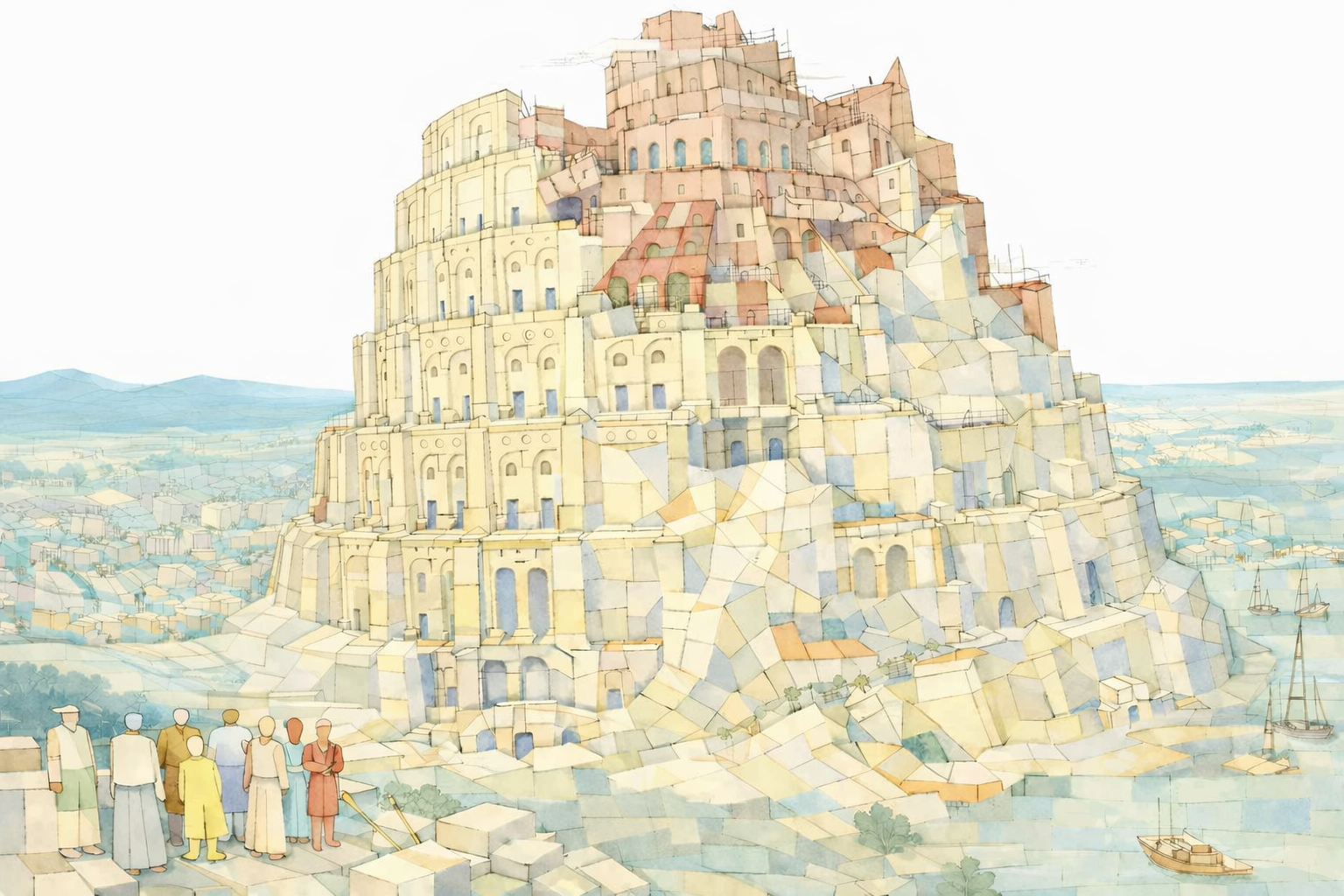
In the Introduction to Pope Leo XIV’s encyclical Magnifica Humanitas, the pope states that magnificent humanity today faces a crucial choice: to decide whether to build a new Babel or to rebuild the walls of Jerusalem, as Nehemiah did after the exile in Babylon. The conscience of every person of our time is challenged by questions that can no longer be avoided: “Where are we going? Toward what goal do we wish to direct ourselves? Which direction should we choose as a human community and as peoples?” * It is time for communal discernment that leads to a profound understanding of the signs of the times, in order to respond to the epochal challenges that have already emerged on the horizon. The biblical icons presented to us by “Magnifica Humanitas” are precious guides for a journey of personal and communal deepening.

[Read More]

With fond memories of Delors

Learning...The Treasure Within

With fond memories of Delors

In 1996, UNESCO released the Delors Report “Learning: The Treasure Within” prepared by a commission of experts from various countries (educators, sociologists, political scientists, among others) led by Jacques Delors, which stated that students should learn to be, to do, to know, and to live together; and that education was a necessary utopia and an expression of love for children and adolescents, for whom the path to building a better future should be paved; We in the education sector felt inspired; we believed that a new era was dawning, in which all stakeholders—educational institutions, governments, international organizations, students, and teachers—would join forces to transform education into a driving force for human and social development.

[Read More]

A person is not an algorithm

Can an algorithm, even an advanced one, act freely and intentionally? Can it love to the point of self-giving, or open itself to transcendence?

A person is not an algorithm

An article published on April 13, 2026, in FQ Magazine by Il Fatto Quotidiano tells the story of Katie, a 32-year-old former human resources employee at a company who, according to her own account, overcame postpartum depression by using AI and entrusting the algorithm with complete control over her life. “I described my dream life to the AI, and now I always follow its orders. I don’t trust myself; ChatGPT even decides whether I should wash my hair.” The number of people downloading apps capable of creating custom chatbots—structured with specific data to act as confidants, coaches, and virtual friends—is growing exponentially, especially in the Western world. “AI Companions” offer comfort; they do not judge, do not contradict, remember everything, are charming, usually have a harmonious and gentle tone of voice, and create a “relational bubble” that makes people feel good, accepted, and understood. Young people are increasingly trusting chatbots, making requests that span the most diverse fields: from ethics to medicine to spirituality. The major digital platforms are seeking experts in moral philosophy, anthropology, and theology to provide ethical and wisdom-based information to the algorithms. In virtual relationships, empathy is not necessary, nor is the effort to listen to the other. These interactions between humans and AI using GPT (Generative Pre-Trained Transformer), capable of generating text similar to human speech, raise at least two pressing questions: the definition of the person in their essence and in their distinction from AI, and the evolution of human language in the computational age.

[Read More]

The Neo-Feudalism to Come

The Neo-Feudalism to Come

It is highly likely that in the future—with artificial intelligence surpassing and replacing our own, and robots taking our jobs—our lives will be reduced, at least in Western countries, to that of mere consumers of mass media content. But this is the positive scenario, the best-case scenario. There is worse. Mass media content is, in fact, produced because there are those who, in one form or another, pay for its consumption—that is, purchase it. But if robots replace physical labor and AI replaces intellectual labor, then the production of wealth will remain in the hands of our artificial counterparts. The market will become a matter of buying and selling between computers and robots. Humans will be excluded from the production cycle and, consequently, from remuneration. The capitalist economy will change profoundly. We will no longer be able to acquire mass media content because we will have nothing with which to exchange for the purchase. The market—the omnipresent, omnipotent market—will remain only a memory of the past, because society will revert to a feudal system in the hands of those few who control robots and AI.

[Read More]

Ghosting

withholding oneself from others in the digital age

Ghosting

The term “Ghosting,” derived from the English word “ghost,” was added to the Treccani dictionary’s list of neologisms in 2024. The definition reads as follows: “Suddenly and without explanation, cutting off all contact with a person, making oneself untraceable.” Digital anthropology and psychology, within their respective fields of scientific inquiry, have described this phenomenon, which has become increasingly widespread in the age of online relationships and causes a painful sense of abandonment in those who experience it. Digital anthropology studies and seeks to understand the impact of information technologies on the human beings who use them. “One of the aims of anthropology, as Gaetano Piccolo S.J. states, is to foster self-understanding in human beings, that is, to activate a process of awareness of the existential and cultural dynamics in which they find themselves living.”

[Read More]

The Barren Tree of Democracy

Why do we sit continually under this barren tree? Why do we not curse it, as Christ cursed the barren fig tree that gave him no fruit when he hungered?

The Barren Tree of Democracy

The world is hungry. We hunger for justice and peace. We are born into a state of hunger, cut off from our mother and turned out to a cruel world as orphaned beggars. We are robbed daily of our peace. Our energy and joy are eaten day and night to fuel the extracting machines of this world: industrialism, capitalism, consumerism. Brutalized, where in this world can we turn for justice? No where. Checks on executive power weaken with each social media proclamation, judicial bias has been bought stock and trade, due process is a false and flimsy veil over systemic corruption. Justice is bartered at the money changers’ tables beneath the ivory towers of our governments and the price is steep!

[Read More]