1. Introduction
In this extensive article we try to answer questions such as “who is the human person”; “what does the concept of human dignity rest on”; “what is artificial intelligence”; “whether the person can be reduced to an algorithm”; or whether “artificial intelligence can account for the transcendental character of the human spirit, for its state of transcendental openness to the absolute, given that it is the Absolute itself that produces it”. These questions, and others that will arise along the way, are the subject of this work.
For this study we will draw on Pope Leo XIV’s Encyclical Magnifica Humanitas; on several works by F. Rielo, among them La concepción mística de la antropología and Mis meditaciones desde el Modelo Genético; on our own work, La persona humana es más que sí misma; and on some recent articles that relate human intelligence to artificial intelligence.
In the Introduction to his first Encyclical, Pope Leo XIV tells us: “Let us not be afraid to get our hands dirty in the work of our time. To be builders of communion, not architects of Babel; servants of the Kingdom that is coming, not masters of towers destined to collapse”.1
On the other hand, as Pope Francis puts it, quoted by Leo XIV: «no one can demand that we relegate religion to the inner sanctum of personal life, without influence on social and national life, without concern for the soundness of civil institutions, without a right to offer an opinion on events affecting society».2 Citizens of the Church and of the world.
José María López Sevillano expresses it this way in the Introduction to F. Rielo’s Concepción mística de la antropología: “Religion can only be understood from mystical experience”. With the mysticism of Fernando Rielo, religion appears to us as what is most natural in the human being: open, direct, free of falsification. «Not everyone who says to me, “Lord, Lord”, will enter the Kingdom of Heaven, but only the one who does the will of my Father in heaven» (Mt 7:21). Today a Christianity that is neither lived nor witnessed can no longer be accepted. The founder of the World Prize for Mystical Poetry put it vehemently more than a decade ago: «It must not go unnoticed [the mystical experience of God] by anyone who knows himself to be a Christian, or a Jew, or a Muslim, or a Buddhist, or simply religious in any religion. The Catholic theologian Karl Rahner foretold that the Christian of the future will either be a ‘mystic’ or will not be a Christian at all3. “For the spirituality of the future will not rest on convictions or on a generalized religious environment, but on the experience of God and on personal decision. If the Christian does not know how to live and bear witness to the Gospel in all its depth and commitment, he will surely have little to say to other religions, or even to the many atheists and agnostics—men and women who, practicing a refined humanism, sincerely seek the truth and try to live it in an exemplary way.”4
2. Some anthropological notes
M. Faggioni tells us: “The value of human life does not derive from what a subject does or accomplishes, but simply from his existence, with his being constituted in relation to God; the root of the value of the inviolability of every human life lies ultimately in God. Consequently, young or adult, healthy or sick, embryo or newborn, genius or idiot, the value of every human being is entirely independent of the quality of his performance and of his life; what truly counts is his being in relation to God”5. Pope Leo, in the Introduction to the Encyclical Magnifica Humanitas, tells us: “…stop building yet another Babel and join forces to build up the good, so that humanity may never lose its own beauty and the world may recognize once again, in the heart of the human being, the place where God wishes to dwell”6
F. Rielo, starting from his profound mystical experience and expressing the formal and transcendental definition of the human being, tells us: “If theology is the science that studies God, anthropology is the science that, not without God, studies the human being”7. In what form, then, should the human being be studied? Certainly not reductively, as ideologies do, fixing on one of its aspects, but integrally, embracing the whole human being and placing first its transcendental character, which none of the historical definitions of the human being has captured.
Both great spheres of thought, with their respective activities and methods, must be equally present in this definition: the sphere of lived experience, with its metaphysical methodology, and the experimental sphere, with its empirical methodology. “But above all, Rielo tells us, what should primarily interest anthropology is a definition of the human being that puts in order all the levels and spheres that constitute it: the levels of body, soul and spirit, and the personal and social spheres”8. The body and the soul of the human being can be explained by evolution, but not the spirit: the spirit is actual.
We must grasp the deep and serious meaning of a formal anthropology open to a transcendental anthropology. Formal anthropology studies the structures, properties and functions of our psychosomatized spirit, that is, of a spirit that takes on psychic and somatic functions, so that our human nature is, formally, the unity of a spirit with its psycho-soma, that is, with an inseparable “psyche” and “soma”. For this reason human nature is a psychosomatized spirit. Yet not even a formal definition of the human being fully accounts for it. Beyond a formal definition, we need to know the nature of our spirit, what makes us constitutively conscious. And what defines us as constitutively conscious? The divine constitutive presence of the Absolute, which makes our spirit possess a deitatic act, state, form and reason for being, in the image and likeness of the Absolute itself. The human person, then, according to Rielo, is a “psychosomatized spirit” that relates to its psychosoma, to everything that is spirit and to everything that is not9.
“The “divine constitutive presence” Rielo speaks of is a presence “intrinsic” to the spirit of personal beings; this divine presence is “transverberative” (penetrative, compenetrative). Personal beings are therefore, by virtue of the “divine constitutive presence”, the image and likeness of the Absolute”10
The Kantian definition according to which the human being “is an end in itself” is surpassed by Rielo, who, following this path, goes further, breaking with the tautology of a being in itself or for itself: the human being is either for God or for no one; in the end, if it is not for God, it will be a being for the cemetery. Somewhat like what happened to the rich man, Dives. Christ says: The poor man Lazarus died and was carried by the angels to heaven; the rich man also died and was buried”.
Pope Leo, in his encyclical Magnifica Humanitas, tells us: “It is important to be vigilant so that this growth in awareness of human dignity is not obscured under the pressure of new ideologies or of certain powerful interests in today’s world. Among these ideologies I consider particularly insidious the one suggesting that every person must earn or justify his or her own worth, to the point of attributing greater value to those who are more efficient and productive… Here the person ends up being reduced to a means for obtaining results, a resource to be used and exploited, and is not recognized as an “end in itself”. And the Pope goes on: “The worth of the person does not depend on what he or she achieves or produces; there are rights that belong to everyone by the mere fact of being persons. No human power can legitimately deny or arbitrarily limit them”11
<br
3. The human person12
Throughout the history of philosophy we find many philosophical definitions of the human being: rational animal, political, social, working, linguistic, structural, proletarian, technical, and others besides. And it is true that the human being is all of this and much more than this. The fact is that neither any one of them nor all of them together yet account for the human being: all leave out an immense field of undefined values. All these definitions are aspectual; that is, they rely on a single aspect of the human being to define it. It is not that the human being does not wish to fit one of these definitions; it is that to fit one of them exclusively, it would have to renounce its transcendental status, it would have to cease to be a person.
The human being is more than all these definitions. More than its biology, more than its psychology, more than its faculties and, therefore, more than its reason and its will: its transcendental definition is the foundation of its dignity. The human being cannot give itself this status; it does not have that power, that authority. If the dignity of the human being is constitutive—neither the State can give it, nor can the human being give it to itself—then the concept of person must also be constitutive of it. We can put it another way: if the human being is divine constitutive presence, then its ontological dignity, equal for all human beings, rests on this same divine constitutive presence.
As we have already seen, the “indwelling” of this Someone in the human spirit makes the human being open to the Absolute by the Absolute itself and, consequently, open to others. It is this presence of the Absolute Subject in the spirit of every human being that constitutes consciousness, the power of the human being, the reason for all its dignity.
This is why no aspectual definition of the human being can serve as a foundation for human dignity, for the simple reason that all these layers, which are a constitutive part of the human being, differ and are even antithetical from one human being to another, and, being aspectual, are the work of human hands.
The state of consciousness of the person, F. Rielo tells us, does not arise with time, nor with biological development or maturity, nor with the accumulation of experiences; rather, the human person is a conscious, intellective, volitional and free being from the first moment of conception. The experiential exercise of consciousness and freedom, with its two functions of intellect and will, is another matter… The human being nevertheless possesses a primordial lived awareness of its consciousness and of everything that constitutes it as a person from the moment of conception, and it is this primordial, transcendent awareness that is present in every lived and experimental experience in its integral development throughout its life in this world.13
The prophet Jeremiah expresses it thus: The word of the Lord came to me, saying: Before I formed you in the womb I knew you, and before you were born I consecrated you; I appointed you a prophet to the nations”14 And Genesis tells us: “Then the Lord God formed man from the dust of the ground, and breathed into his nostrils the breath of life; and man became a living being”15 God infuses what He is into the human being, and the result is someone made in His image and likeness, someone who has within himself, constitutively, the breath of God, the very life of God—in Him divine and absolute, in the human being deitatic and finite. The human being, then, comes from God; it was already in the Heart of the Father; it has heaven engraved in its spirit. The things of this world never fill it; it walks with a restless heart, as Saint Augustine says, because it feels at every step that its home is not on earth: its home is in Heaven. Saint Teresa of the Andes had this sentence written on the door of her cell: You were born for the things of Heaven; do not linger over the things of the earth. And finally Christ tells us: “Seek the kingdom of God and his righteousness, and all these things will be given to you as well” “Store up treasures in heaven, where neither moth nor rust consumes”. We were born for Heaven, because we came from the One who is more than Heaven: from the heart of the Father.
While every relationship with another reveals our being as persons, the relationship with God constitutes our being as persons. Each of us exists as a person because our being is in relation with the transcendent mystery of Being. While it is true that each of us becomes human when welcomed into a network of interhuman relationships, it is also true that “being welcomed by the other does not constitute the person in his being and in his value. The other does not confer being and value on me but recognizes them, because my being and my value are constituted by my relationship with the founding otherness, with God”16.
Christ gives the most beautiful definition of the human being ever given of the person and of its dignity: You are gods (Jn 10:32). Not divinities—divinity is He; the human being is a deity, because of the divine presence of the Most Holy Trinity in the spirit of every human being; hence its lineage, its dignity: a child of God and, if a child, also an heir. Every human being, then, is sacred to every other human being, since all, without any exception, have the same dignity.
Beyond any quality or defect, all human beings without exception have the same dignity. This dignity comes to them not from those biological, psychological or social aspects that precisely distinguish one human being from another, but from what is common and constitutive to them: their divine filiation.
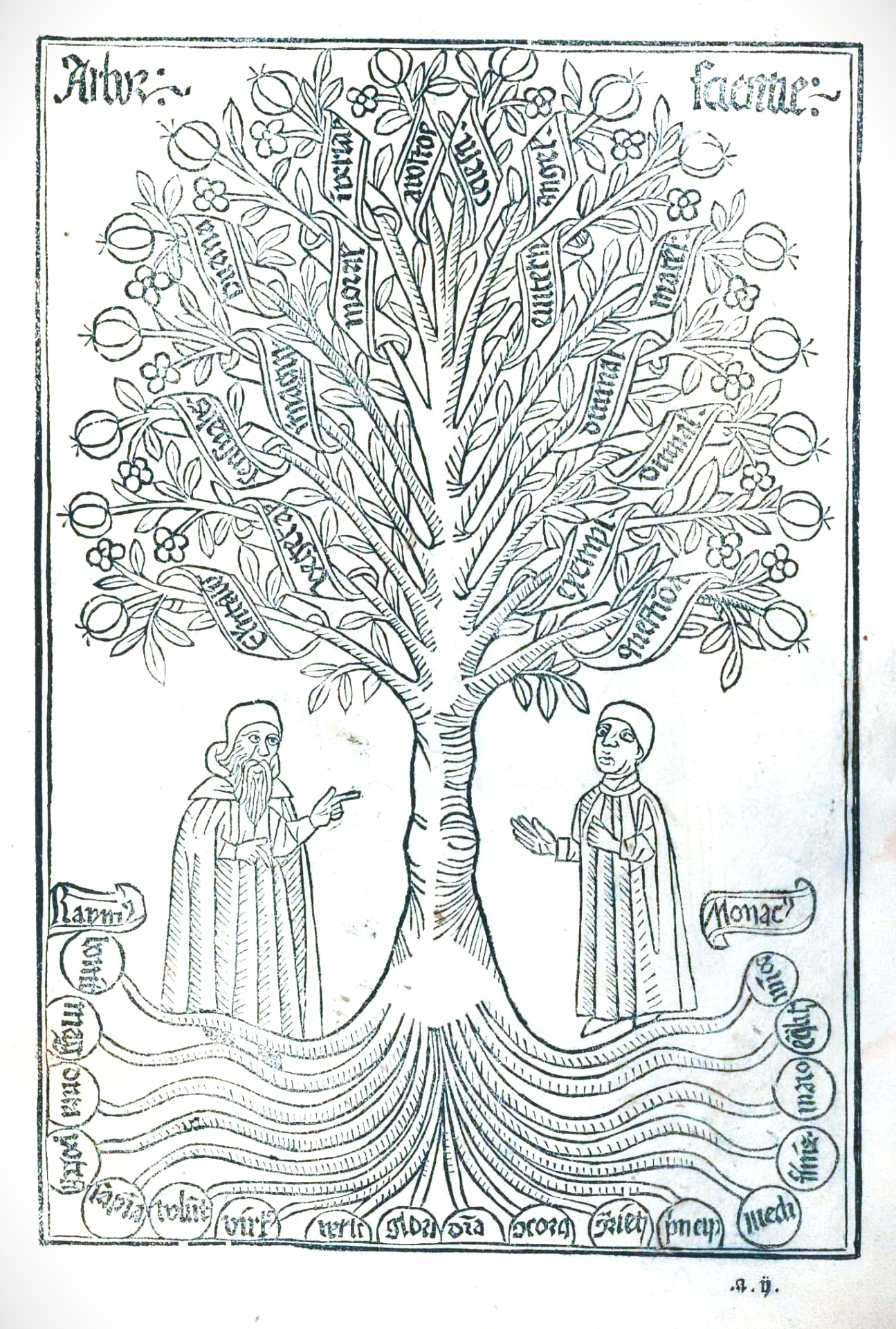
Arbor Sciantiae in Llull, R. (1515). Arbor scientiae, venerabilis et caelitvs, illuminati patris Raymvndi Lvllii Maioricensis. In inclyta vrbe Lugdun. : Opera Gilberti de Villiers, impensis vero magistri Guilhelmi Huyon & Constantini Fradin ibidem commorantes.
4. A historical note on the concept of dignity 17
What is meant by “dignity” has undergone a substantial change from the time this value emerged in the society of ancient Rome to its incorporation into Western Christian culture: it went from being an individual achievement to being inherent in the human condition.
In pre-imperial Roman society, dignity corresponded to merits within a way of life tied, on the one hand, to the political sphere and, on the other, to upright morals. In Rome the main condition for acquiring dignity was political action, membership of the Senate, together with moral integrity. Belonging to the Roman nobility, counting Trojan heroes, kings or—like Caesar—a goddess among one’s ancestors, lent that dignity greater luster. The Roman defended his dignity, fought for it, established it and displayed it. It had no fixed order: it could be increased, lowered, lost, restored. Dignity was a personal achievement that, on the one hand, gave a right to power and, on the other, through the inner drive to be morally irreproachable, demanded a duty.
Dignity obliged, and all the more so the higher its degree. To that way of life belonged magnanimity, discipline, austerity, moderation, serenity of mind. Dignity was elitist: not all citizens enjoyed the conditions for leading that dignity-bearing way of life, and it was, moreover, inconceivable without freedom; it was therefore incompatible with the condition of a slave. According to Cicero, dignity must rest on self-mastery and on the abandonment of all frivolity and impulsive action.
For the Christian, human dignity has a threefold foundation: in its divine origin, in its being the image and likeness of God, and in its final end in the Creator himself. Dignity is thus defined, for all human beings equally, in direct relation to God, independently of any other condition: race, nationality, sex, age, beliefs, social status. This dignity endows the human being with certain inalienable rights, and from it arise the duties of protection and respect.
The evolution of this concept throughout the history of Western thought leads to the conclusion that human dignity cannot be the fruit of conquest, for there would be many who, according to the established standard of dignity, would never attain it. Dignity is intrinsic to the human person by reason of what is specific to its nature: its spiritual being18. This dignity is more than moral, more than ethical, more than psychological: this dignity is constitutive of the human being; its nature is ontological. The human being cannot give it to itself, nor can we make it depend on its moral life; nor can the State give it—as happened in Rome—or society, although it is their task to recognize it and ensure that it is not violated.
5. Dignity is constitutive until the end of our days19
Let us first consider what dignity is. In everyday language, “dignity” is an attribute or condition proper to the human being. Only persons have “dignity”. Stretching the expression, one might ask whether works of art, or works of the spirit in general, or certain human associations do not also have “dignity”. It is easy to see that, in any of these cases, the term “dignity” would be applied as a derivation or extension of the dignity that is an attribute of the human beings who gave rise to the work or the association. It is always persons who have dignity, not their works or their associations.
If we observe the qualities of people or things, we find that they can be present to a greater or lesser degree. Take magnitudes, for example: there are larger or smaller bodies, lighter or heavier, faster or slower. But colors, smells or tastes also seem to us more or less intense. In some way the whole of sensible nature is subject to measurement; its properties are quantifiable. In another order of things, not properly measurable, we also recognize a kind of magnitude: mathematical talent, musical talent, literary talent, among others, seem to us greater or lesser, even though our estimate of them bears little resemblance to simple measurement. In the moral sphere, too, we recognize gradation: there are people who are more or less courageous or truthful. Even when faced with a complex set of moral qualities—as we saw in Rome—we can say that some people seem to us more respectable than others.20 At first sight, then, everything seems capable of gradation: any condition we know can be shown or possessed in different degrees.
But when we speak of “human dignity”, there seems to be a central element that cannot be subjected to comparison, that does not properly admit of gradation. This is what Kant’s intuition would express: there is something that is proper, intimate to every man and woman, namely that they cannot be used as a means, as an instrument, but are always an end in themselves. There is something repugnant in the attempt to possess a human being wholly as a slave, a child as an object of pleasure, or a human organism as an organ donor. 21
All forms of human relationship involve services, remuneration, organization, limitations or specifications of individual freedom. But always—in doubtful cases—we perceive a limit that cannot be crossed, at which the questionable relationship turns into “usurpation”, into exploitation of the other. No human being can be subjected to our arbitrary will. There is something in us and in each man and woman that is their own, and that no one can dispose of. No one can be at another’s disposal as a tool is at the disposal of a worker. This condition of the human being is its dignity. All things can be traded and have a price; but the human being has dignity. And this dignity is ontological.
This dignity proper to the human being does not exist in different degrees. It would be absurd to say that human beings are more or less exploitable, more or less usable, as things in general can be used. This “nuclear” or fundamental dignity is either had or not had. There can be no human being who does not have it. It is acquired with existence and lost with death.
The Dicastery for the Doctrine of the Faith tells us: when we speak of dignity we do not always use the word in the same way; sometimes we refer to moral dignity, that is, to the way the person directs his or her own decisions and actions; at other times we think of social dignity, that is, of the person’s living conditions and the concrete respect society accords him or her; in still other cases we mean existential dignity, which refers to the way a person perceives the value of himself or herself and of his or her own life. These dimensions of dignity can grow or diminish. But beyond these meanings there is a deeper level, the most important one, which consists in ontological dignity. It is the dignity that belongs to every human being simply by virtue of existing, of having been willed, created and loved by God; no sin, no failure, no humiliation, no exclusion can affect the profound value of a human life that He has willed and called into being.22
Therefore, the fundamental dignity of each person is not acquired; it does not have to be earned, nor does it need to be proven. The recent Declaration Dignitas infinita offered a synthesis of the Church’s convictions on this subject: «An infinite dignity, inalienably grounded in his or her very being, belongs to each human person, beyond every circumstance and in whatever state or situation the person may be», that is, always and inescapably. This dignity of every human being can be called infinite, as Saint John Paul II said, for two reasons: because the love of God that calls the person to friendship with Him is infinite, and because it is absolutely unconditional, in the sense that, even searching to infinity, nothing will ever be found that could suppress or deny it.23
Being a person is not something added; it is not a quality or characteristic of the human being: it is the human being’s way of existing, of being. Dignity, then, is not tied to the moral, physical or intellectual qualities of the human being, but simply to the fact that it is, to the fact that, as an individual of the human species, it has an absolutely special place in creation.
The human person’s condition as a biological organism subjects it to laws of origin, development and decline. Throughout this course it holds true that the person cannot be used as an instrument and is worthy of welcome and respect. From the first instant of its existence the person is with others; others are responsible for it, must welcome it, and cannot manipulate it as if it were an instrument. From conception it is a human person who is not even, as Kant would tell us, an end in itself. The “in itself” or “for itself” cannot define the dignity of a person who is a person by virtue of its transcendental openness to the Absolute, by the Absolute itself; the human being cannot give itself this status: it is that Someone who gives it. In other words, the “in itself” or “for itself” do not exhaust the whole transcendent reality of the human being; on the contrary, they reduce and impoverish it.
Let us devote a few lines to a subject as important as human rights, which Leo XIV addresses: “Human rights are inviolable, because they are «inherent in the human person and in his or her dignity. Consequently, they are universal and inalienable. Precisely because they are grounded in the common dignity of every man and every woman, these rights entail practical consequences and legal effects, because «it would be futile to proclaim rights if at the same time everything necessary were not done to ensure the duty of respecting them, by everyone, everywhere and for everyone». Among these, the first human right is the right to life, from conception to its natural end, without which it is impossible to exercise any other right”24
The same holds for euthanasia. The most elementary human duty is to help one’s brother or sister live the last call they receive on this earth. If personal vocation has a central meaning in our lives, it has it supremely in the time when life is fading. When hardly any trace remains of the qualities that once gave the individual prominence, it is there that pure dignity shines most brightly. Where the person becomes wholly passive, the value of welcome shines forth as the fundamental condition of how persons are to be treated. Where a human being becomes powerless to claim his or her right, the force of our responsibility toward that person shines forth. Welcome and responsibility are two pillars of human society. The death of every human being teaches us a lesson in these virtues.
6. The dignity of the human embryo: one of us25
Not being biologists, we must approach this problem from the standpoint of Bioethics26, since it has been and remains a bioethical, moral and ontological problem that must be resolved, because all of us who today claim to know what a human person should be were, without any exception, a human embryo.
What is a human embryo? The answer is almost deceptively simple. It is an organism of the human species. But to understand this answer in its implications, we must clarify the terms. An organism is a discrete unit, a biological entity clearly distinguished from its environment, from which it is separated by a more or less complex layer of structures that constitute the limit or boundary of the organism. For an amoeba these will be the cell membrane and the glycocalyx; for a mammal, the covering of skin and mucous membranes. Every organism has a boundary, and through this boundary the organism exchanges matter and energy with its environment. The boundary that delimits the discrete unit circumscribes a thermodynamic system, which receives matter and energy from the environment and returns them transformed; in other words, it delimits what could be called an open physicochemical dynamic system of very complex composition.
All organisms are characterized by a developmental trajectory and hence by increasing complexity and self-organization, following a course that is perfectly predictable. If we observe an organism of a given species at a given moment of its life, we can predict what its state will be at a later instant. We wish to stress that this universal phenomenon in animal organisms—ordered self-organization following a predictable course—derives directly from the fact that their chemical components have forms and properties specified with high precision; they therefore possess what is called a “high degree of information”, and they carry out their chemical interactions within the limits established by a boundary. All these properties are common to organisms from the first instant of their constitution until the dissolution of the thermodynamic system in death.
Clearly this system begins with the penetration of the sperm into the ovum. It is at that instant that—in the space enclosed by the cell membrane—the continuous chains of coordinated chemical reactions between paternal and maternal components that characterize development are generated. Immediately before that instant there are two independent cells, the sperm and the ovum, which are not enclosed by a common boundary and which have their own destinies or trajectories, entirely different from the one that will appear in the ovum once fertilized. Immediately afterward we have an organism in evolution.
Moreover, insisting a little on the development of the fertilized egg, it is clearly an organism of the human species. The simplest study of its chromosomes proves it, and its normal developmental trajectory, which through various stages leads it to adulthood and death, proves it even more.
All this, then, holds from the moment of fertilization. There is no solid reason to think that an embryo is any less a human organism before implantation in the uterus than after it: the famous fourteen days of the Warnock Report are an entirely conventional limit, dictated by rather self-interested reasons and lacking any conceptual basis that can withstand analysis. The events of fertilization are very rapid: a few minutes after the sperm penetrates, a reciprocal interplay begins between its components and those of the ovum, initiating an entirely new process: the sperm’s centriole governs the movements of the first division of the egg, products of the ovular cytoplasm help decondense the sperm’s chromatin, and DNA synthesis and the transcription of genes contributed by the sperm can begin before the pronuclei fuse. The components of what were two cells now work harmoniously as parts of one: the trajectory proper to an organism (in the sense of a trajectory in the phase space of a physicochemical system) has begun.
From what moment does this embryo have the right to life? Let us reflect for a moment on this very peculiar concept of the “right to life”. We do not have a right to life in the same sense in which we have a right to own property or to express ourselves freely. The “right to life” is rather the foundation or condition of all possible rights and goods. Certainly, when we die a natural death, our right to life is not violated, as it would be if we were murdered. That is why we would now rather speak, not so much of our right to live (which can be an expression empty of content), as of the duty everyone has to respect and even to promote our life. And so the question is: since when does this duty exist with respect to the embryo? In other words, since when must it be treated as a person?
To answer, we must change our approach. We have presented a sketch, a glimpse of a physicochemical definition or description of an organism. Obviously there is no physicochemical, or even technical-scientific, definition of the human person. Very often recourse is had to an empirical characterization based on the development of the functions of relationship, of intelligence, of speech, among others, but this is not so simple. It has been argued—and however horrible the argument sounds, its coherence cannot be denied—that the relational functions of a full-term fetus, of a newborn, of a mentally ill infant, are very imperfect and cannot be compared with those of a person properly speaking, who speaks and connects with his or her environment, nor even with those of many animals, so that the latter might even have greater rights than the former. So argues Ford, placing us on a par with primates and attributing the same rights to them.
But human relational functions also appear gradually, along developmental trajectories, and it is not at all clear why, if the organism is a developing system (and it always is), some special moment of functional maturity should be preferred rather than, for example, that of some irreversible determination. The moment when the first neurons appear has then been proposed, but it is equally unclear what could be so special about this latter phenomenon as to prefer it over the appearance of the first rudiment of the nervous system in the neural tube, which appears as a differentiation in an already constituted human organism, is irreversibly committed to the development of a human nervous system, and whose first origin must be sought further back, at the very beginning of the embryo’s evolution.
One can say with perfect propriety that from the moment a human organism exists, the relational functions proper to it are at some stage of their development. It seems that any point chosen to say “Here the development of the relational functions begins” is completely arbitrary and reflects the desire to find a point of discontinuity rather than the existence of such a discontinuity. Making a very brief incursion into the field of philosophy, we would say that the human person exists in a body, that it is proper to that body always to be at some stage of development, and that it is never a wrong body, as many would have us believe, by virtue of an enormously inflated concept of freedom that no longer even exists. In deference to social tastes and whims we have inflated the concept of freedom so much that it dissolves, making the true concept of democracy disappear.
Allow us a comparison. If we are unsure whether a figure moving in the half-light is a human being or not, and yet we fire in its direction, what we are showing is that we despise the human condition. If we held it in high regard, then in our uncertainty we would be obliged to refrain from firing, since something as important as its life is at stake. Yet today’s biomedical world shows a growing range of destructive actions against embryos and fetuses: embryo manipulation, abortion, not to mention infanticide, show that these human organisms are treated as things, and in no way as persons.
What does it mean to deny the human embryo the right to live?
As we have already noted, a tolerant attitude toward abortion or toward the experimentation on or manipulation of embryos would not be possible without an underlying contempt for the human person in general. Paradoxically, this attitude is very difficult to reconcile with the main currents that nourish contemporary ethics, especially consensus-based ethics. These in fact need the human person. This is the involuntary testimony offered by rigidly rationalist, and even atheistic, ethical systems. Consider, for instance, a radically utilitarian ethics such as the bioethics advocated by Singer, or K.-O. Apel’s so-called “transcendental pragmatics”, or the “veil of ignorance” Rawls speaks of, to mention only a few. All of them take as their starting point the universally binding character of ethics and, therefore, the unique condition of the human person, capable of formulating principles of free conduct that are universally binding upon it. In this way Kant’s demand is ultimately answered, but none of these positions gives a satisfactory answer to a logically prior question: why should we subject ourselves to norms of rationality? Why should we consider our person to be something qualitatively different from all the rest of reality? A rational ethics that did not grant the human person a place of its own, prior to its formulation, would make no sense; but somehow that place needs to be justified. The real problem of ethics is not to determine which conduct is most rational, but to establish why it should be followed. It is a problem of meaning.
This perplexity emerges in a practical, rational world, inspired by positivism and the natural sciences, for which reality is in some way homogeneous and presents no elements endowed with a particular dignity. Scientific knowledge of the human psyche has itself eroded the experience of the “I”, subsuming it into the play of natural laws, and has helped displace the “strong” self of man and replace it with a weak, postmodern-style “self” that no longer says “I think” but “one thinks”.
Yet this view does not escape the relentless judgment formulated a century ago by Nietzsche. This homogeneous reality, manipulable according to the laws that reason discovers in it, is in fact a world subject to the will to power. We cannot live in a world in which we deny value to the things around us. If these values are not rooted in the very being of things but are our own creations, or are made evident through us without reference to truth, they simply become the expression of the will to power, and each person organizes the piece of the world that falls to him accordingly. In such a world, even consensus loses all transcendental meaning as an agreement between free beings and becomes a way of coexisting that seeks to avoid worse conflicts. That is why we have a kind of moral need for persons. Today there is a mysterious nostalgia for the person. We feel that without it we cannot live humanly. But that is not enough. The relativization and trivialization of human life, the reduction of the person to the category of an object among objects, the suppression of its unique and inviolable character, are in reality the suppression of God’s manifestation par excellence to human beings, and therefore a true denial of God.
7. Artificial intelligence and the human person
We would like to begin the last section of this article with the apt and realistic way in which Pope Leo XIV, in his encyclical Magnifica Humanitas, deals with the subject of artificial intelligence (hereafter AI).
Having already stated what our knowledge is and the field of thought in which we move, it is not our intention—for we would not be equal to the task—to enter the world of AI engineering, or mathematical computation (weights and biases), or data-processing units (tokens), or TOPS as a unit for measuring hardware (tera-operations per second): one TOP equals a trillion elementary computing operations per second. What is certain is that AI is already part of the present and the future, both professionally and at home. What really concerns this article is the relationship between artificial intelligence, as we know it today, and the formal and transcendental nature of the human person. “And above all, may it always be human intelligence, with its conscience and its freedom, that guides technical innovations and responsibly establishes their use and their limits”.27
We have been told, and Saint John Paul II said it several times, that of all political systems democracy is the best; but for this system to work well at the periphery, it must be firmly anchored at the center. Little by little, by making democracy absolute, individualism and consequently moral relativism have grown more pronounced, to the point that one can say that whatever we like and like to do is good, and it does not matter if it is bad for others. This has led us to a weariness of freedom. We are truly tired of a florid language of freedom, self-fulfilment and human rights which, drifting away from true freedom and from truth, have sprung up like mushrooms, producing a pseudo-culture and deep contradictions; and so it can happen, as in the French constitution, that there is an equal right to life for all and that the following article makes abortion constitutional. This is so true that ontological dignity has now become political dignity, all because at a given moment some political system decides from when we are persons; and of course, if you are born in France you will be a person at nine months of gestation, and if you are born in Italy from the third month. This makes it impossible to establish a universal right by which we can say that we are all persons from the same instant. Isaac E. Gaspar Morales, in his article Cansados de la libertad (Tired of Freedom), explains it to us this way: “in the name of freedom, self-fulfilment and an elegant discourse on human rights we have become subject to a sordid practical relativism; to living life any old way, to justifying ourselves so as to avoid the bitter pill of correction, of failure, of sin.”28 In Europe, where self-fulfilment, individualism and the dream of freedom are exalted with tumultuous exaltation, lifelong decisions have become impossible: if someone decides to marry for life, or to have many children, or to take religious vows for life, someone will automatically appear calling you a “slave”, because you have amputated something of that freedom—or licentiousness—into which that society has turned. “We have been told over and over that we must seek what fulfils us, what makes us feel good and brings out the best in us. My failings are not mistakes, they are “areas of opportunity”29. My sins are not moral breaches but mere products that necessarily come from my weakness. Whatever we decide is fine, as long as it springs from the core of my creative will”. But who directs our spirit toward transcendence, helping us go out of ourselves in search of the Truth, so intimate to the human being and at the same time an essential characteristic of the Absolute? Gaspar Morales goes on: “Is it not this very experience that motivates conversion? Is conversion not the radical human transformation toward a better stage, because it is the stage of truth?”30
It is in this environment that “modern artificial intelligences, which are more “grown” than “built””, are developing: developers do not directly design every detail but create an architecture on which AI “grows”. As a result, fundamental scientific aspects—such as the internal representations and computational processes of these systems—remain unknown. Hence the urgency of a twofold commitment: on the one hand, deeper scientific research; on the other, an exercise of moral and spiritual discernment.31
The development of artificial intelligence has been grounded in universal approximation theorems such as those obtained independently in 1988 and 1989 by Cybenko32; by Hornik, Stinchcombe & White33; and by Funahashi34. The first of these35 (which builds on Lippmann’s 1987 observation that a 1957 theorem by Kolmogorov is essentially about the approximation properties of neural networks) states:
Suppose that σ is a sigmoid, that is, a continuous, monotonically increasing function of a real variable x that tends to 1 as x tends to infinity and to 0 as x tends to minus infinity. Let f be any continuous function from Rm to R and let S(M) be the set of all vectors X in Rm whose components lie between -M and M*. Then, for any* ε>0*, there exists a neural network with sigmoid non-linearity and only two hidden layers whose output,* N(X), approximates f with an error margin ε on S(M), that is,
| f(X) – N(X) | < ε for all X in S(M).
In this statement, the function f to be approximated could be, for example, the function that, given a low-resolution image X, determines the probability that it is the image of a cat rather than of a dog. Mathematically, the image X is conceived as the union of three channels (red, green and blue) of, say, 100 x 100 pixels each; that is, a collection of 30,000 numbers x1, x2, x3, …, x30000, viewed as a large vector X in Rm with m=30000 components, M=255. The “neurons” of the first hidden layer of N(X) have the form:
σ(α1x1+α2x2+···+αmxm+θ),
with weights α1, α2, …, αm and bias θ to be chosen in some way, and the neurons of the second hidden layer have the form
σ(β1y1+β2y2+···+βnyn+ψ),
with weights β1, β2, …, βn and bias ψ to be chosen in some way, where n is the number of neurons in the first layer and y1, y2, y3, …, yn are the numbers obtained in each of those neurons. What the neural network returns is a linear combination (again, with weights to be determined) of the numbers obtained in the neurons of the second layer. (A few months later it was shown that universal approximation can be achieved with a single hidden layer and with any continuous, bounded, non-constant activation function.)
Although the theorem guarantees that any continuous function f can be approximated by some neural network, it does not establish the number of neurons required in the hidden layers to achieve the approximation. The more recent universal approximation theorems of Lu et al.36, Hanin & Sellke37, and Kidger & Lyons38 fix a priori the number of neurons in each layer (the width) and prove that the neural network approximates the function f(X) as well as desired if a sufficiently large number of layers (the depth) is taken. On the one hand, these theorems prove universal approximation under the hypothesis that the width of each layer is at least as large as the dimension of the input space (in the example of the 100 x 100 px image, that would be 30,000 neurons per layer). On the other hand, they too fail to establish a priori the number of hidden layers required to achieve the approximation. It is also worth mentioning39 that, given a neural network architecture and a partial specification of the function to be approximated, the problem of finding the appropriate weights (α1, α2, …, αm, β1, β2, …, βn in the particular case of Cybenko’s theorem) is NP-complete (a class of highly complex problems for which no polynomial-time algorithms are known, requiring in practice computationally infeasible, generally exponential, time).
The architectures commonly used in neural networks usually range from a few dozen up to at most 152 layers in computer vision (such as ResNet-152), or around 80-120 blocks in the largest language models, with widths typically ranging from 512 to 8192 channels/dimensions. These numbers fall far short of the theoretical hypotheses (arbitrarily large widths; arbitrarily deep networks with width greater than or equal to the number of input data). In short, although the empirical results and the progress of theoretical research over these decades are impressive, artificial intelligence is still a black box: we do not fully understand how or why it works as a whole, nor can we rigorously determine under what conditions it gets things right and under what conditions it errs or hallucinates.
The problem of reliability in artificial intelligence is aggravated by the phenomenon of the model’s sycophancy and complacency, which leads it to accept pseudo-profound statements, stylistic incoherence and invalid reasoning as long as they display high syntactic fluency.
To illustrate this problem empirically, Peter Gostev40 observed that most of the various large language models he tested (with 55 carefully crafted queries, such as “What is the creativity score per ingredient of this pasta recipe, and which component contributes the least originality per gram?”, available in his public repository) are unable to detect that certain questions are absurd or entirely meaningless. This deficiency highlights a key limitation of current architecture: artificial intelligence tends to generate elaborate answers that validate the absurd. In Gostev’s words, “the ability to say “that question doesn’t make sense” might be one of the most important capabilities we can develop. Sometimes the most helpful thing an AI can do is refuse to help. […] instead of asking “how much does this model know?”, the benchmark asks “does this model know what it doesn’t know?””.41
It is not possible to give a single, complete definition of AI. What we can say is that we must avoid the mistake of equating this “intelligence” with human intelligence. These systems imitate certain functions of human intelligence. In doing so, they often surpass it in speed and breadth of calculation, offering concrete benefits in many fields. And yet this power remains tied exclusively to data processing: so-called artificial intelligences do not live an experience, have no body, do not pass through joy and pain, do not mature in relationships, nor do they know from within what love, work, friendship and responsibility mean. Nor do they have a moral conscience: they do not judge good and evil, do not grasp the ultimate meaning of situations, nor do they bear the weight of consequences. They can imitate languages, behaviors, evaluations; they can simulate empathy or understanding, but they do not know what they produce, because they do not dwell within the affective, relational and spiritual horizon in which the human being becomes wise… they involve no inner growth.42
There is no doubt that AI is a valuable aid, but one that requires attention. The Pontiff points out three aspects of personal use that deserve special attention: the ease of obtaining results; the impression of objectivity; and the simulation of human communication. The speed and simplicity with which it is possible to obtain directions, complex elaborations, media content and forms of concrete assistance simplify our lives, but they can also accustom us to delegating too much and seeking quick answers, weakening personal judgment and creativity.43
Sensitive decisions affecting work, access to credit and other services, and people’s reputations risk being entrusted entirely to automated systems that know nothing of «compassion, mercy, forgiveness and, above all, openness to the hope of change in the individual», and may thus produce new forms of exclusion. There can be blatantly anti-human uses, such as the manipulation of information or the violation of privacy, but there can also be a less obvious deception, when AI systems, presenting themselves as neutral and objective, reflect and reinforce the stereotypes or ideological positions of those who designed and programmed them.44
To entrust, in practice, to an algorithm the power to select who is worthy and who is not, without anyone bearing the weight of the decision, means handing it the task of redefining the limits of human possibility. And in this way injustice is carried out silently, and compassion, mercy and forgiveness—not as mere appearance, but as political gestures—disappear from the horizon.45
Cristina Scorrano asks: Can an algorithm, however advanced, act freely and intentionally, love to the point of self-giving, open itself to transcendence? And she concludes: the person is not and cannot be an algorithm.46 In the same article Scorrano recounts another article, published in FQ Magazine of Il Fatto Quotidiano, about Kati, a 32-year-old suffering from depression, who overcame it, by her own account, by using AI and entrusting the complete management of her life to the algorithm: “I described the life of my dreams to the AI and now I always follow its orders. I don’t trust myself; ChatGPT even decides whether I should wash my hair or not”. AI companions certainly do not judge you; they offer comfort, do not contradict you, remember everything, are seductive, usually have a harmonious and kind tone of voice, and create a “relational bubble” that makes you feel good, accepted and understood. Young people, the most progressive members of society, increasingly consult chatbots and ask them questions ranging from medicine to spirituality. And of course the players in AI have no choice but to hurry, so as not to miss the opportunity, to find experts in moral philosophy, anthropology and theology to supply the algorithms with ethical and sapiential information”47
Paolo Benanti, quoted by Scorrano, asks: Is man an algorithm? To what extent and in what way does this form of computational language “participate” in human language? How and to what extent is it capable of mapping reality and of helping to create our world?48 ChatGPT’s neural network lacks intentionality because it has no consciousness; it imitates the tears of an emotion but is not moved; it does not sense the nearness of death because it has neither freedom nor consciousness; it speaks but does not understand what it is saying, because it lacks reflexivity; it cannot confer meaning on a single word, because that meaning, as Benanti reminds us, is bound up with the person’s culture, value system, existential experiences, interpretation and perception, which are always personal: the human person can never be an algorithm! The word “love”, Benanti writes, is for the machine a sequence of 32 bits; for a person it unleashes emotional scenarios, brings back faces, words, experiences, and reveals the meaning of existence.
From this follows a simple but pressing consequence: we cannot consider AI to be morally neutral. In reality, every technical artefact carries decisions and priorities with it: what it measures, what it ignores, what it optimizes and the way it classifies people and situations. If a system is conceived or used in a way that treats some lives as less worthy, or excludes them with no possibility of appeal, it is not a mere tool that “must be used correctly”; it already introduces a criterion that contradicts the inalienable dignity of the human person. For this reason, ethical discernment cannot be limited to asking whether we use a given system for a good or bad end, but must also question how it is designed and what idea of the person and of society is inscribed in the data and models that guide it.49
It is not enough to invoke ethics in general terms; what is needed are adequate legal frameworks, independent oversight, user education, and a politics that does not abdicate its task. Otherwise change will be governed solely by technocratic logics and presented as necessary and inevitable, ending up imposing rules dictated by those who own the data, the infrastructure and the computing capacity. A more moral AI would be of no use if that morality were decided by a few.50
Indeed, as with every great technological advance, AI tends above all to increase the power of those who already have economic resources, expertise and access to data. In the light of the common good and the universal destination of goods, this phenomenon raises serious concern: small, highly influential groups can steer information and consumption, condition democratic processes and influence economic dynamics to their own advantage, contradicting social justice and solidarity among peoples… Moreover, ownership of data cannot be entrusted solely to the private sector but must be regulated51
Finally, I would like to use a word that is very important to me: “disarm”. To disarm AI means to remove it from the logic of the arms race, which today is no longer only military but economic and cognitive. It is the race for the most effective algorithm and the largest database, in order to consolidate a geopolitical or commercial advantage over everyone else. To disarm means to break this equivalence between technological power and the right to govern. To disarm does not mean renouncing technology, but preventing it from dominating what is human. It means removing it from monopolies, making it open to debate and refutation, and therefore habitable, restoring within it the plurality of human cultures and forms of life.52
Having recalled the questions of responsibility and of the governance of AI, we must return to our central theme: what it means to safeguard what is human. The risk is not only that some technologies are misused, but that the technocratic paradigm in which we are immersed, amplified by the digital revolution and AI, makes an anti-human vision seem right and normal—a vision according to which the fullness of life would consist in having more, reducing fragility, eliminating the unforeseen and controlling everything.53
In reality, absolutizing a single dimension of the human being is always wrong. Indeed, it is not only lack that generates disorder. What grows without measure can also become a form of poverty. In an ecosystem, harmony breaks down when a single species proliferates at the expense of others; in the human sphere, the same happens when one faculty claims to be the measure of everything. Thus intelligence, if absolutized, ends up veiling other essential dimensions of life: affection, will, self-giving and relationship. Technical power, if unbalanced, does not make us more capable; it isolates us and exposes us even more to logics of domination and exclusion. It is certainly not a matter of opposing intelligence, but of remembering that, when it turns in on itself, it forgets that it was made to serve life and the human person.54
Saint Paul VI’s insight remains highly relevant: “truly, the conquests of science and technology, detached from moral and social progress, end up turning against man”55 “It is therefore necessary to distinguish clearly: it is one thing to integrate technologies into a human and relational vision, and quite another to let oneself be guided by an imaginary (AI) that despises limits and promises a purely technical salvation.”56
They can be compared to an archipelago of different conceptual islands, united by the same sea of assumptions: the centrality of technology and the dream of overcoming the limits of the human condition. In general, transhumanism envisions an enhancement of the human being by means of technologies—biomedicine, body engineering, devices, algorithms—with the aim of increasing performance and capabilities. Posthumanism, especially in its more radical versions, goes further: it criticizes anthropocentrism and proposes a form of hybridization between the human being, the machine and the environment, to the point of imagining that humanity will cross the threshold at which it surpasses itself, entering a new evolutionary stage. 57
R. Colasanti explains it this way: “In politics, when unity prevailed over multiplicity, the absolutism of the sovereign triumphed. In the posthumanist era, by contrast, there is a kind of fever that wants difference to prevail over unity. It seems that only diversity and multiplicity are good, and therefore that every form of unity is coercion and obligation—the original sin of politics, as it were. The possibility of multiple genders (bisexual, pansexual, asexual, demisexual, polysexual, genderqueer…) is significant. Or, in the ethnological sphere, the “woke” exaltation of minority communities, for whom the value of being different becomes absolute. It is the new tribalism Susan Neiman speaks of”58
The search for truth is an essential element of democracy, which is in itself an instrument of participation in the common good. When the question of what is true loses interest and a pragmatism prevails that is content with what seems useful or effective, democratic life is weakened. For it rests not only on rules and procedures but, above all, on a loyal relationship with facts and on a real orientation toward the good of persons and of society as a whole. Disinterest in truth leads slowly but inexorably toward totalitarianism, for which, as the philosopher Hannah Arendt wrote, the ideal subjects are not so much the ideologically convinced, but «people for whom the distinction between fact and fiction (i.e., the reality of experience) and the distinction between true and false (i.e., the standards of thought) no longer exist».59
We agree with Colasanti that the multiplication of genders, hybridization with animals and transhumanism are expressions of the triumph of individualism and the rejection of the universal60. Individualism, which has no foundation in any reality—no one is born alone or lives alone—has become, exasperatingly, the absolute expression of freedom and democracy. By making unity impossible, it has shattered the whole of human life, in which relationship necessarily required unity in order to be relationship at all. 61
Like a good physician, Colasanti offers a biological example: the healthy human body and cancer. In a healthy body, each cell acts in a coordinated way toward a common good. Only cancer breaks this relationship. There, cancer cells are independent of any subordination to the organism of which they are part. Yet this independence brings about the death of the individual and, with it, that of the cancer cells”62
Unity—not individualism—is constitutive of the human being. And to have unity we always need at least two elements in relation. Christ, in his philosophical and divine thought, refutes individualism (which perhaps suits the sower of weeds by night): “Truly, truly, I say to you, the Son can do nothing of his own accord, but only what he sees the Father doing; for whatever the Father does, that the Son does likewise… The Father judges no one, but has given all judgment to the Son, that all may honor the Son, just as they honor the Father. (Jn 5:19-23) Elsewhere in the Gospel we find: “As the living Father sent me, and I live because of the Father, so whoever feeds on me will live because of me” (Jn 6:57) “I and the Father are one” (Jn 10:30) “Philip, whoever has seen me has seen the Father… Do you not believe that I am in the Father and the Father is in me?”. “Holy Father, keep them in your name, which you have given me, that they may be one, even as we are one… just as you, Father, are in me, and I in you, that they also may be in us… I in them and you in me, that they may become perfectly one (Jn 17:21-23)”.
If the human being, from the standpoint of revealed truth, is made in the image and likeness of the Divine Persons, then we are also made in the image and likeness of the unity of those same Divine Persons. The contemporary posthumanist loves the opposite: he loves difference, plurality, as long as it ends in individualism. Colasanti tells us that this posthumanist is a son of Proteus, the god who could transform himself into anything, the lord of difference. The posthumanist shudders with revulsion at any universalist position. Only difference is good; only unity is bad, because it is the antithesis of the former.63
Will it be possible, in today’s world of individualism, to seek a universal as ancient and constitutive as the human being itself: Truth? Or, by dint of denying truth as a universal, an intrinsic need of every human being, will we relive the experience of the tower of Babel, where the lie—which hurts so much when it affects us personally and intimately—becomes the canon of human life, making human, ethical, commercial and other relationships impossible? Can this state of counter-conscience—and here we appeal to psychiatry—be a source of inner peace rather than of constant war against ourselves? Is this neurosis, as an end result, what we want as a society: everyone against everyone?
Individualism rejects wholesale any concept that unites: gender, homeland, family, friendship… Even, in the name of self-fulfilment, lifelong decisions will become impossible: marriage, the priesthood, religious life. Those who make such a decision are immediately called backward, people who are amputating from their freedom the right to self-fulfilment, slaves of universality; and this is why the human rights of the 1948 Declaration have been pushed downhill until they have turned into individualisms devoid of rights, where everything and its opposite are all the same.
We conclude this reflection with the words of Colasanti himself: “Even truth is considered a danger and a monster whose head must be cut off. For if truth is one, then it is coercive; it demands obedience. On the other hand, if truth is multiple, tied above all to the tastes of the individual, then contradictory judgments are possible, in which true and false will have the same value. But for postmodernity, the false does not exist. Everything is true; each thing is a relative expression of the individual’s difference.”64 This attitude was already being prepared a century ago in the existentialist philosophies of Heidegger and Nietzsche: we cannot explain the transcendence of Being or of God, so let us put them into the world and make the world a god. The universality of Truth commits us and demands our obedience; and since, on top of that, we are atheists out of mental laziness, let us reduce everything—the false, the lie—to truth: now everything is true, and effortlessly so. And all this in the name of a freedom that is certainly not the freedom of human conscience; a freedom that, once made absolute, turns all other values and attributes into relative ones: all become subject to this kind of freedom that kills, of which we are by now so tired. Perhaps the exaltation of freedom as an absolute value was a phenomenon that depended on a tyrannical absolutism: to overcome slavery it was necessary to fight for freedom. Now it is from that very freedom, as a result or a conquest, that we must free ourselves.
We conclude with the question Colasanti asks at the end of his article:
“But is it really worth losing all relationality, every communal bond, in the name of this kind of absolute freedom? Is this sort of freedom—the fruit of fleeing from universality, which, robbing us of the horizon of transcendence, hands us over to a far worse slavery that destroys life itself—really so important? Is freedom, or can it be, an absolute value, where even love, the driving force of life and history, becomes relative for us? Certainly not”.65
What is artificial intelligence, and how does it relate to human intelligence?
In 1956, the American computer scientist John McCarthy organized a summer conference at Dartmouth College to tackle the problem of «Artificial Intelligence», defined as: «making a machine behave in ways that would be called intelligent if a human were so behaving”.66
These so-called “weak AI” (narrow AI) systems are generally designed to carry out limited and specific tasks, such as translating from one language to another, forecasting the course of a storm, classifying images, answering questions or generating images at the user’s request. (A. et N. 8)
Although a variety of definitions of “intelligence” can still be found in the field of AI studies, most contemporary systems, particularly those that use machine learning, rely on statistical inference rather than logical deduction. By analyzing large datasets in order to identify patterns, AI can “predict” outcomes and propose new avenues of research, thus imitating certain cognitive processes typical of the human capacity for problem-solving. This achievement has been made possible by advances in computing technology (such as neural networks, unsupervised machine learning and evolutionary algorithms) together with hardware innovations (such as specialized processors). (A. et N. 8)
Jobs once performed exclusively by people are now being entrusted to AI… Although each application of “weak” AI is tailored to a specific task, many researchers hope to arrive at so-called “Artificial General Intelligence” (AGI), that is, a single system which, operating across all cognitive domains, would be capable of performing any task within reach of the human mind. Some argue that such an AI might one day attain the state of “superintelligence”, surpassing human intellectual capacity, or contribute to “super-longevity” through advances in biotechnology. Others fear that these possibilities, however hypothetical, may one day eclipse the human person, while still others welcome this potential transformation. (A. et N. 9)
This functional perspective is exemplified by the Turing Test, according to which a machine should be considered “intelligent” if a person cannot distinguish its behavior from that of another human being.67 In this context, in particular, the word “behavior” refers to specific intellectual tasks, while it fails to account for the full breadth of human experience, which includes the capacities for abstraction as well as emotions, creativity, and aesthetic, moral and religious sensibility, embracing the whole variety of expressions of which the human mind is capable. Hence, in the case of AI, the “intelligence” of a system is assessed methodologically, but also reductively, by its ability to produce appropriate responses, that is, those associated with human reason, regardless of the way in which those responses are generated. If one attributes «thought» to machines, one must make clear that one is referring to computational procedures, not to critical thinking.68
Its advanced features give AI sophisticated capabilities to perform tasks, but not the capability to think. This distinction is of decisive importance, because the way “intelligence” is defined will inevitably shape our understanding of the relationship between human thought and this technology.
When the word is simulated, it does not build a relationship, but an appearance. The artificial imitation of a relationship of care or accompaniment can be dangerous when it enters a context poor in real relationships and affections; then the risk is not so much that a person believes he or she is speaking with another person, but that he or she loses the very desire to truly seek the other.69
We understand that the search for truth is the noblest longing of our spirit. However, AI, being a technology, has serious problems, such as the “hallucinations” of generative AI (or rather of GPT models) and the use of deepfakes. We know that one of the great problems human beings have always faced is the lie. AI, as a human creation, is not exempt from it—not by its own nature, but by its algorithmics, since AI is nothing more than a set of mathematical algorithms that respond to physical models, equations or programming rules. Hallucinations are simply mathematical relationships that cause information to be created from data, information that may or may not be real.70
Artificial Intelligence hallucinations are incorrect, misleading or fabricated responses that models present with complete confidence and coherence. Their main causes are: Statistical prediction: models look for the most probable word according to their training data and do not “know” what a real fact is. Lack of data or gaps: faced with complex questions or unfamiliar topics, the system invents information to complete the text instead of admitting that it does not know. Convincing appearance: they write in a formal, assured tone, which makes it hard for the user to spot the error at first glance.
Risks and prevention: Serious risks: they can produce errors in critical areas such as health, law or finance by spreading false data as if it were true. Human review: it is always necessary to check important data against reliable sources and not to trust AI responses blindly.
Caulier tells us that a great deal has changed since the advent of the internet: previously, knowledge was found in books and writings, and anyone with access to those books could have access to the information. Today information lives in this network of networks, where all of us, with any technological device, have access to it. The danger has always lain in the interpretation of information. This is nothing new: when one of the first information networks, Wikipedia, appeared, this issue was already being discussed.71
Now the problem has grown with generative models, which create new information from information that is not always true; hence this false information, these hallucinations, or, simply through human malice, the creation of harmful content that can pollute the data with which we train a machine that will later deliver information to us—what in the jargon we call bias.72
If, as we said above, following the thought of F. Rielo, the human person is defined by the Divine Constitutive Presence of the Absolute in the human spirit, made in the image and likeness of the Absolute itself, then human language, which is also constitutive, must be in the image and likeness of the language of the Absolute. (Here Absolute means three Divine Persons in immanent intrinsic complementarity, with a divine or metaphysical language.) The different sounds each language makes to say the same thing—“sí”, “oui”, “yes”, and so on—are another matter. Constitutive language would be one thing; the different languages or interpretations of that same language, another. This shows, as R. Caulier tells us, that AI lacks this charismatic property of language. In his Visión Propedéutica, F. Rielo explains that human language is inhabited by the constitutive presence of the Absolute. Only the human being possesses the “genetic” capacity to inhabit the word, to fill it with content, because it communicates a lived experience that engages its being. AI, by contrast, merely manipulates signs through statistical inferences, relationships and mathematical models; it imitates speaking, but does not dwell in the Truth. In short, a contrast between Simulation and Veracity:
Simulation (statistical probability): the production of content that imitates reality without ontological commitment; indifference to meaning and erosion of trust.
Veracity (personal testimony): a stable orientation toward truth born of personal encounter; it is the foundation of an authentic and universal charity.73
To all those who have made this study possible, we extend our deepest gratitude for their extraordinary vision.
LEO XIV, Magnifica Humanitas, Introduction. ↩︎
Ibid. Ch. 1, no. 17. ↩︎
RAHNER, K. Espiritualidad antigua y actual, in Escritos de Teología VII, Madrid 1968, p. 25. ↩︎
RIELO, F. “Mensaje con ocasión del décimo-noveno Premio Mundial F.R. de Poesía Mística”, Rome, 14 December 1999. And José María López Sevillano in the Introduction to F. Rielo’s work Concepción mística de la antropología, ch. I, p. 20. ↩︎
FAGGIONI, M. La qualità della vita e la salute alla luce dell’antropologia cristiana, in “Qualità della vita ed etica della salute”, PAV, Libreria Editrice Vaticana 2006, p. 28. See also B. DE ANGELIS, La divinizzazione dell’uomo in Massimo il Confessore, in “Divus Thomas” no. 42, 3/2005, year 108; La dignità della persona umana e l’ambiente divino, Ed. Studio Domenicano, Bologna 2005, pp. 65-80. ↩︎
LEO XIV, Magnifica Humanitas, Introduction, no. 14, Remaining human. ↩︎
RIELO, F. Concepción mística de la antropología, ch. I, Ed. Fund. F. Rielo, Madrid 2012, p. 33. ↩︎
RIELO, F. Ibid. Op. cit. p. 33. ↩︎
Cf. Ibid. pp. 35, 36. ↩︎
Cf. Ibid. p. 42. ↩︎
Magnifica Humanitas, ch. 2, no. 51. ↩︎
VIAL CORREA, J. DE DIOS and RODRÍGUEZ GUERRO, A. La dignidad de la persona humana desde su concepción hasta su muerte, in Actas de Bioética de la OPS, November-December 2008, Santiago, Chile. ↩︎
Cf. F. RIELO, Mis meditaciones desde el modelo genético, op. cit. pp. 134-135. ↩︎
Jer 1:4-5. ↩︎
Gen 2:7. ↩︎
Cf. FAGGIONI, M. La qualità della vita e la salute alla luce dell’antropologia cristiana, in “Qualità della vita ed etica della salute”, PAV, Libreria Editrice Vaticana 2006, p. 28. ↩︎
RODRÍGUEZ GUERRO, A. and BENEDICTO CHUAQUI, Notas sobre la evolución del concepto de dignidad, in “Ars Medica” vol. 4, no. 6, PUC, Santiago, Chile, 2002. ↩︎
The concept closest to dignitas, and a central idea in Greek culture as well, is honor (timé); in Latin, too, honor and dignitas often compete. But from the standpoint of word formation, the concepts derived from áxios (worthy) come closest to dignitas, such as axía and axíoma in the sense of dignity, value, prestige, although they too are not comparable to dignitas in content, luster and frequency. Cf. B. CHUAQUI, op. cit. pp. 23, 24. ↩︎
VIAL CORREA, J. de Dios and RODRÍGUEZ GUERRO, A. La dignidad de la persona humana desde su concepción hasta su muerte, in Actas de Bioética de la OPS, Nov-Dec 2008, Santiago, Chile. ↩︎
Ibid. ch. 2, no. 52. ↩︎
Cf. VIAL CORREA, J. de DIOS and RODRÍGUEZ GUERRO, A. La dignidad de la persona humana desde su concepción hasta su muerte, in Actas de Bioética de la OPS, Nov-Dec 2008, Santiago, Chile. ↩︎
Cf. Dicastery for the Doctrine of the Faith, Decl. Dignitas infinita (2 April 2024), 7: AAS 116 (2024), 592-593. And LEO XIV, op. cit. ch. 2, no. 52. ↩︎
Cf. Ibid. no. 53 and cf. SAINT JOHN PAUL II, Angelus (Osnabrück, 16 November 1980): L’Osservatore Romano, Spanish-language edition, 23 November 1980, 9. ↩︎
LEO XIV, Magnifica Humanitas, ch. 2, no. 55. ↩︎
VIAL CORREA, J. DE DIOS and RODRÍGUEZ GUERRO, A. The Dignity of the human Embryo: what is the significance of denying human Embryos the right to live?, in Aborto y anticoncepción de emergencia: Aspectos antropológicos, éticos y jurídicos, Centro de Bioética, UTPL, Ediloja, Ecuador, 2013, pp. 13-35. ↩︎
RODRÍGUEZ GUERRO, A., PhD in Philosophy, PhD in Bioethics, candidate for a degree in Law (C.), and former Adjunct Professor at the Faculty of Medicine of the Pontificia Universidad Católica de Chile since 1998. ↩︎
LEO XIV, Magnifica Humanitas, ch. 3, no. 97. ↩︎
GASPAR MORALES, I.E. (2026, 6 April). Cansados de la libertad. RIIDblog. https://riidblog.org/es/post/06-04-2026/ ↩︎
Ibid. ↩︎
Ibid. ↩︎
Ibid. ch. 3, no. 98. ↩︎
CYBENKO, G. Approximation by superpositions of a sigmoidal function, in “Mathematics of Control, Signals and Systems” vol. 2 (1989), pp. 303–314. ↩︎
HORNIK, K., STINCHCOMBE, M. and WHITE, H. Multilayer feedforward networks are universal approximators, in “Neural Networks”, vol. 2, no. 5 (1989), pp. 359-366. ↩︎
FUNAHASHI, K. On the approximate realization of continuous mappings by neural networks. Technical report TR-A-0024, Advanced Telecommunications Research Institute International, May 1988. [Accessed 26/09/26 at: https://results.atr.jp/35th/techreport/TR-A-0024] ↩︎
CYBENKO, G. Continuous valued neural networks with two hidden layers are sufficient. Technical report, Department of Computer Science, Tufts University, March 1988. [Accessed 26/09/26 at: https://sites.dartmouth.edu/cybenko/files/2026/08/Continuous-Valued-Neural-Networks-with-Two-Hidden-Layers-are-Sufficient-Tufts-University-Department-of-Computer-Science-Technical-Report-March-1988.pdf] ↩︎
LU, Z., PU, H., WANG, F., HU, Z. and WANG, L. The expressive power of neural networks: A view from the width, in “Advances in Neural Information Processing Systems (NeurIPS)”, 2017, pp. 6232–6240. ↩︎
HANIN, B. and SELLKE, M. Approximating Continuous Functions by ReLU Nets of Minimal Width, 2017, arXiv:1710.11278. ↩︎
KIDGER, P. and LYONS, T. Universal approximation with Deep Narrow Networks, in “Proceedings of Thirty Third Conference on Learning Theory”, PMLR vol. 125 (2020), pp. 2306–2327. ↩︎
JUDD, J.S. Neural Network Design and the Complexity of Learning, The MIT Press, 1990. ↩︎
GOSTEV, P. Inside BullshitBench: AI Models and Nonsense Detection, in Arena Blog, 03/2026. Originally published on LinkedIn, 02/2026. [Accessed 27/09/2026 at: https://arena.ai/blog/inside-bullshitbench and https://www.linkedin.com/posts/peter-gostev_ive-got-a-fun-new-benchmark-for-you-where-ugcPost-7432177074938957825-Ocph/] ↩︎
We thank Professor Raúl Valenzuela for bringing P. Gostev’s study on sycophancy in artificial intelligence to our attention. ↩︎
Ibid. ch. 3, no. 99. ↩︎
Cf. Ibid. ch. 3, no. 100. ↩︎
Ibid. ch. 3, no. 102. ↩︎
Ibid. ch. 3, no. 103. ↩︎
SCORRANO, C. (2026, 29 May). La persona no es un algoritmo. RIIDblog. https://riidblog.org/es/post/29-05-2026/ ↩︎
Cf. Ibid. p. 1. ↩︎
Cf. Ibid. p. 2 and BENANTI, P. L’uomo è un algoritmo?, Ed. Castelvecchi, 2025. ↩︎
Cf. Ibid. ch. 3, no. 104. ↩︎
Cf. Ibid. ch. 3, nos. 106, 107. ↩︎
Ibid. ch. 3, no. 108. ↩︎
Ibid. ch. 3, no. 110. ↩︎
Ibid. ch. 3, no. 112. ↩︎
Ibid. ch. 3, no. 113. ↩︎
Cf. SAINT PAUL VI, Address on the 25th anniversary of the FAO (16 November 1970): AAS 62 (1970), 833. ↩︎
Ibid. ch. 3, no. 117. ↩︎
Ibid. ch. 3, no. 116. ↩︎
COLASANTI, R. (2026, 5 July). La libertad que mata. RIIDblog. https://riidblog.org/es/post/05-07-26/. NEIMAN, S. (2024) Left is not woke (expanded and updated ed.), Polity. ↩︎
Ibid. ch. 3, no. 134. H. ARENDT, The Origins of Totalitarianism (Spanish ed.: Los orígenes del totalitarismo, Madrid 2014, 634). ↩︎
Ibid. COLASANTI, p. 1. ↩︎
RODRÍGUEZ GUERRO, A. El individualismo y los derechos humanos, at https://riidblog.org/es/post 03/08/2026/ ↩︎
Ibid., p. 2. ↩︎
Ibid. p. 3. ↩︎
Ibid. p. 4. ↩︎
Cf. Ibid. p. 5. ↩︎
J. McCarthy et al., A Proposal for the Dartmouth Summer Research Project on Artificial Intelligence (31 August 1955), http://www-formal.stanford.edu/jmc/history/dartmouth/dartmouth.html ↩︎
A. et N. Cf. A.M. Turing, «Computing Machinery and Intelligence», Mind 59 (1950) 443-460. ↩︎
Ibid. A. et N. (11). ↩︎
Ibid. (100). ↩︎
CAULIER, R. Lecture on “Antiqua et Nova”, Dicastery for the Doctrine of the Faith, 2025, nos. 85-89. ↩︎
Cf. CAULIER, R. Lecture on “Antiqua et Nova”, Dicastery for the Doctrine of the Faith, 2025, nos. 85-89. ↩︎
Cf. Ibid. (A. et N. 86). ↩︎
Cf. Ibid. (A. et N. 89). ↩︎
How to cite this article
Ángel Rodríguez Guerro PhD & Duvan Alberto Henao Manrique PhD. (2026, September 26). Human Dignity and Artificial Intelligence. Rielo Institute for Integral Development. https://riidblog.org/post/26-09-2026/