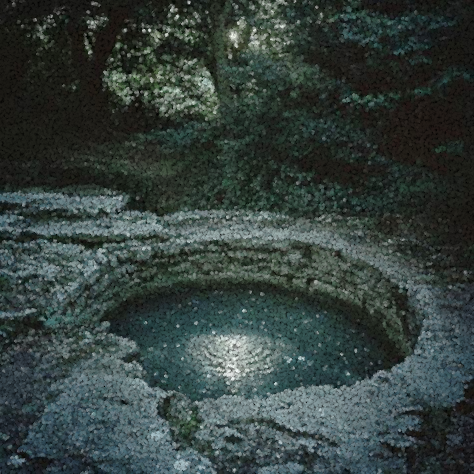
There are dialogues, written in memorable books, that leave their mark on us and settle in our memory; mysteriously, they return to our thoughts like sparks from a fire.
In Leonardo Sciascia’s novel The Day of the Owl (Il giorno della civetta), the mafioso don Mariano Arena, addressing Captain Bellodi of the Carabinieri, says: “Truth is at the bottom of a well: you look into a well and see the sun or the moon; but if you throw yourself in, there is no longer sun or moon, there is the truth.”1
In the digital age, does it still make sense to “go down to the bottom of a well” in search of the truth? How should we stand, today, before what John Paul II calls “the crisis of truth”, “the loss of universal points of reference for truth”?2
Is the search for the truth about oneself, about the world, even about God, a constitutive trait of the human being? In an age dominated by technology and AI, how can we exercise critical thinking to stem the drift towards “sheer power devoid of truth, which subtly or openly imposes what it wants others to regard as true” (Magnifica Humanitas, 133)?3
The question of truth has always been central to philosophy. In ancient Greece the word for truth is alētheia (from the privative alpha and lēthē, meaning “hidden”): truth is what is “manifest, unveiled, what comes to light”. Before philosophy, the word of myth and the inspired word of the poets unveil the truth of reality and defy time, making heroes and their deeds immortal; with the seer’s gift proper to poets, they bring to light what the gods have decreed and what is invisible to the eye.
With Plato, truth is no longer alētheia but orthotēs, that is, “exact correspondence between the Ideas and the realities of the world”.4 Truth acquires a universal, absolute dimension. The Ideas, eternal and unchangeable, dwell in the Hyperuranion, and only the soul, which originally dwelt there, can gain knowledge of them. The path of knowledge that leads to truth is, for Plato, anamnesis, that is, “recollection, reminiscence”: the memory of the realities with which the soul came into contact in the Hyperuranion. Only through the soul, imprisoned in the body, can man arrive at Truth. In the Phaedo Plato states:
We shall come all the closer to knowledge the less we have to do with the body, (…) we shall not let ourselves be contaminated by the nature of the body, but shall keep ourselves pure of it (…) we shall know in the purity of our soul all that is pure: and this, I think, is the truth.5
Here the body/soul dichotomy is born, which has so deeply shaped Western philosophy.
The famous allegory of the cave, too, traces the path that leads man to the recognition of the Ideas, to the truth. Once the wise man has freed himself from imprisonment in the cave and from the illusory vision of reality, once he has contemplated the Truth, he must return to the cave to free those still imprisoned in darkness; truth is liberation, healing from the deceptive appearance of worldly things.
In a dialogue that remained unfinished, the Critias, Plato also defines the power of persuasive words, which can manipulate the minds of men. “Persuasion,” the philosopher writes, “accompanies both words of truth and words of deceit; whoever possesses it can use it like a rudder, according to his own designs.”6
In the encyclical Magnifica Humanitas, Pope Leo XIV discerns the persuasive and manipulative power of technological means:
Those who have powerful technical and economic resources at their disposal – and with them also many human resources with which to act – have a considerable capacity to bring about cultural change and, ultimately, to convince a significant number of people of what the truth is about the human being, about the world, about the meaning of existence, about the family, even about God.
In the age of AI it is urgent to rediscover the value of the search for truth and of developing critical thinking, aware that we are facing a technology whose boundaries we cannot see and whose implications we do not fully know. We are now immersed in an “infosphere”,7 as the philosopher Luciano Floridi calls the digital world, in which the representation of reality carries more weight than reality itself. Truth can be “constructed” and made to serve the interests of the few who hold power over digital media. F. Nietzsche’s thought seems to have prevailed: there are no “facts”, only “interpretations”, and the status of truth, deprived of any universal reference, is regarded as a manifestation of man’s will to power. Nietzsche writes in On Truth and Lies in a Nonmoral Sense:
What is truth? A mobile army of metaphors, metonymies, anthropomorphisms; in short, a sum of human relations that have been poetically and rhetorically heightened, transferred and embellished, and which after long use seem to a people firm, canonical and binding: truths are illusions whose illusory nature has been forgotten.
In a volume of unpublished writings by M. Foucault, History of Truth, the philosopher, discussing the problem of truth, argues that truth is always rooted in a historical context and that there is a relationship between power and knowledge: every power “constructs” its own knowledge, its own truths.8
Returning to the illuminating words of Pope Leo’s encyclical, we can reaffirm the metaphysical foundation of truth, and that a society is “noble and worthy of respect” because of its attachment to fundamental truths and because it promotes the search for truth (Magnifica Humanitas, 133). Truth should be regarded as a “common good”: it is the foundation of democracy, and it is nourished by dialogue, by verification, by shared responsibility, by truthful and transparent communication, by trust, by fidelity to facts. Indifference to truth is dangerous for the life of each individual and for the civil and political life of society, also and above all in the digital age.
For Christians, Truth is Christ, “the way, the truth and the life”; following Christ, who stays silent before Pilate when he asks Him, in a judgmental tone, what truth is, Christians should commit themselves to bearing witness to the truth through a coherent and authentic life and a concern for the common good.
In De vera religione, Saint Augustine states that Truth dwells within the inner self. Truth is the light, the illumination that comes from God, who is in every human being.
“If truth dwells in every human being,” says the philosopher U. Galimberti, “to renounce the search for truth means to renounce being human.”9
L. Sciascia, Il giorno della civetta, Adelphi, 1993. ↩︎
St John Paul II, Encyclical Letter Veritatis Splendor, 6 August 1993, 32. ↩︎
Leo XIV, Encyclical Letter Magnifica Humanitas, 15 May 2026, 133-134. ↩︎
M. Heidegger, L’essenza della verità, Adelphi, 1997. ↩︎
G. Reale – D. Antiseri, Il pensiero occidentale dalle origini ad oggi, La Scuola, 1988. ↩︎
Plato, Crizia, ed. A. Belli, Società editrice Dante Alighieri, 2001. ↩︎
L. Floridi, Etica dell’intelligenza artificiale, Raffaello Cortina Editore, 2025. ↩︎
M. Foucault, Storia della verità, Einaudi, 2026. ↩︎
U. Galimberti, Le disavventure della verità, Feltrinelli, 2025. ↩︎
How to cite this article
Cristina Scorrano. (2026, October 24). If Truth Lies at the Bottom of the Well…. Rielo Institute for Integral Development. https://riidblog.org/post/24-10-2026/