AI, Original Sin, Justification—three traditional terms that we should scrutinize in order to overcome the risk of becoming human beings enslaved: to ourselves, to history, and to technologies—technologies that grant us the knowledge that empowers us, but not the wisdom to live as free human beings, that is, with intelligences that are: volitional to seek the truth, intentional to do good, and spiritual to transcend by creating beauty.
I asked AI what the five most important contributions it provides to the human mind are, and the five most significant risks the human mind faces with the use of AI. These were its answers. (The contributions are written in regular font and the risks in italics, to facilitate a clear comparison.)
1- Expanding our capacity to process information. Management of mass disinformation.
2- Enhancing medical diagnostics. Violation of privacy and encouragement of brain drain.
3- Real-time language translation and communication. Bias in algorithm handling and discrimination based on variables.
4- (Intentional) modeling of scientific discoveries. Cybersecurity vulnerabilities.
5- Personalized education tailored to each person’s potential skills. Impact on employment, instability, and a lack of loyalty between employees and companies.
It is very interesting to observe the relationship between the benefits and risks that AI warns us about. This is the reality of our existence: there is no benefit without a cost, nor any human truth that cannot be falsified. That is why it is important not to be dazzled by the narrative of the Tree of the Knowledge of Good and Evil with which AI can subjugate us, because it would condemn us to the barrenness of the lie engendered by laziness and the fear of having to work to become wise—and we would be repeating Original Sin. The tradition of Original Sin—which requires hermeneutics (interpretation) to grasp the meaning of the message it contains—as narrated in Genesis 2 and 3, just like AI, presents both benefits and drawbacks.
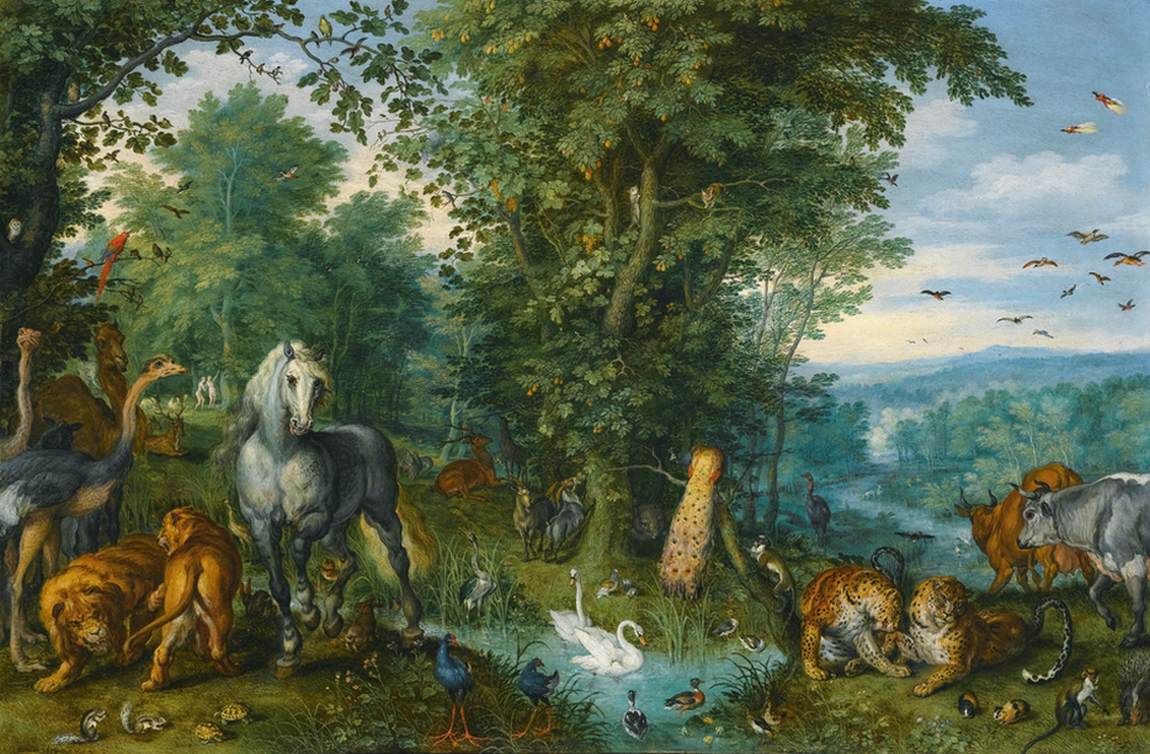
1- The serpent was the most cunning of all created beasts and spoke (through the ear of her conscience) to the woman (the origin of all living human beings). The woman replied, “God has told us: if we eat of the fruit of the tree of life and wisdom (necessary and essential to fulfill the command to tend and keep Eden), we will die” (Gen. 2:15).
2- “On the day you eat of it, your eyes (of your conscience) will be opened, and you will be wise, like God, to rule over the earth.” The woman realized that the fruit of the tree was good and desirable for gaining wisdom… self-justification (an elegant lie).
3- The eyes of both of them were opened, and they saw that they were naked. they hid from God’s sight among the trees of the Garden… fear of being discovered.
4- “Where are you, Adam? I heard you in the Garden and hid because I was afraid—I was naked (because I ate from the tree you forbade me to eat from, so I wouldn’t have to tend and cultivate the Garden, Gen. 2:15) … laziness.”
5- The woman you gave me as a companion offered me the fruit, and I ate it. he serpent seduced me, and I ate… Justification, a cascade of lies, born of laziness and fear—*of having to study, work, and develop creativity—in obedience to the command to be a creative part of nature.
The cost and the overcoming of any human truth are subject to a cost-benefit analysis that we will try to justify as if it were the truth. Truth can only be personal and shared among people; that is why Jesus Christ went so far as to say “I am the Truth”; no one else in the history of humanity has been able to say it or deny it. But we confuse it with the certainty of our scientific knowledge—subject to the law of falsifiability—and with the belief that we can make our desires a reality. The contributions of AI are marvelous and therefore captivating, but above all else stands out the empowerment it grants us for the development of spiritual and transcendent intelligence, which will allow us to be wise, because it affords us ample time to seek, expand, and enjoy the truth and beauty contained within every human person. All of this requires overcoming the laziness and fear that overwhelm us like a neo-original sin, the very essence of which is the mythomania that prevails in our world today.
If we use AI to guard and cultivate the Garden of Eden (Gen. 2:15) of human beings and nature, it will help us develop our transcendent intelligence, which will allow us to continue living beyond time; we will not die. And if we use AI to discover, encourage, and create beauty (in the body, mind, and spirit) among people collectively, socially, and communally, we will develop our spiritual intelligence and will not need to resort to lies (or justifications) to feel successful or powerful.
We will thus overcome the “neo-original sin” that leads us to the collective belief that mythomania is a way of life (everyone lies, we all lie, so it must be good; it’s enough that it’s agreed upon and/or democratically legalized). Is overcoming this through Spiritual and Transcendent intelligence a utopia? Yes, because utopia is “the perfection of the possible”—and this is possible.
How to cite this article
Julián Aparicio Garrido PhD. (2026, July 18). AI, the New Language of Original Sin. Rielo Institute for Integral Development. https://riidblog.org/post/18-07-2026/