This famous verse by David Maria Turoldo introduces this brief – and certainly not exhaustive – reflection on ‘justice’, a theme that is often at the heart of debates and demands. Let us ask ourselves what the meaning of the term “justice” is in a globalised, multicultural society dominated by market forces and technology, and, above all, on what foundation can the concept of “justice” be anchored if religious and moral references are no longer valid or shared? Is a society that speaks the language of weapons just? These days, the terms most frequently heard in public debate are those relating to war, violence, the death of innocent people, and armed attacks. It seems that humanity is prey to an insatiable thirst for power and is capable only of devising plans for destruction, aggression, and the invasion of spaces belonging to others. Pope Leo XIV, too, in the Angelus on Sunday 15 March, drew attention to the “dramatic situations of injustice, violence and suffering that mark our times”.
An era also characterised by dangerous authoritarian tendencies, whilst Western citizens, as the philosopher J. Habermas—who passed away on 14 March—states, tend to become “isolated monads acting solely on the basis of their own interests”. The common good seems to remain in the background, and the social fabric shows signs of disintegration, often marginalising the most vulnerable and denying their rights. Reflection on justice is the subject of the research and thought of J. Habermas, the German philosopher who has recently passed away, to whom we would like to dedicate a brief tribute.
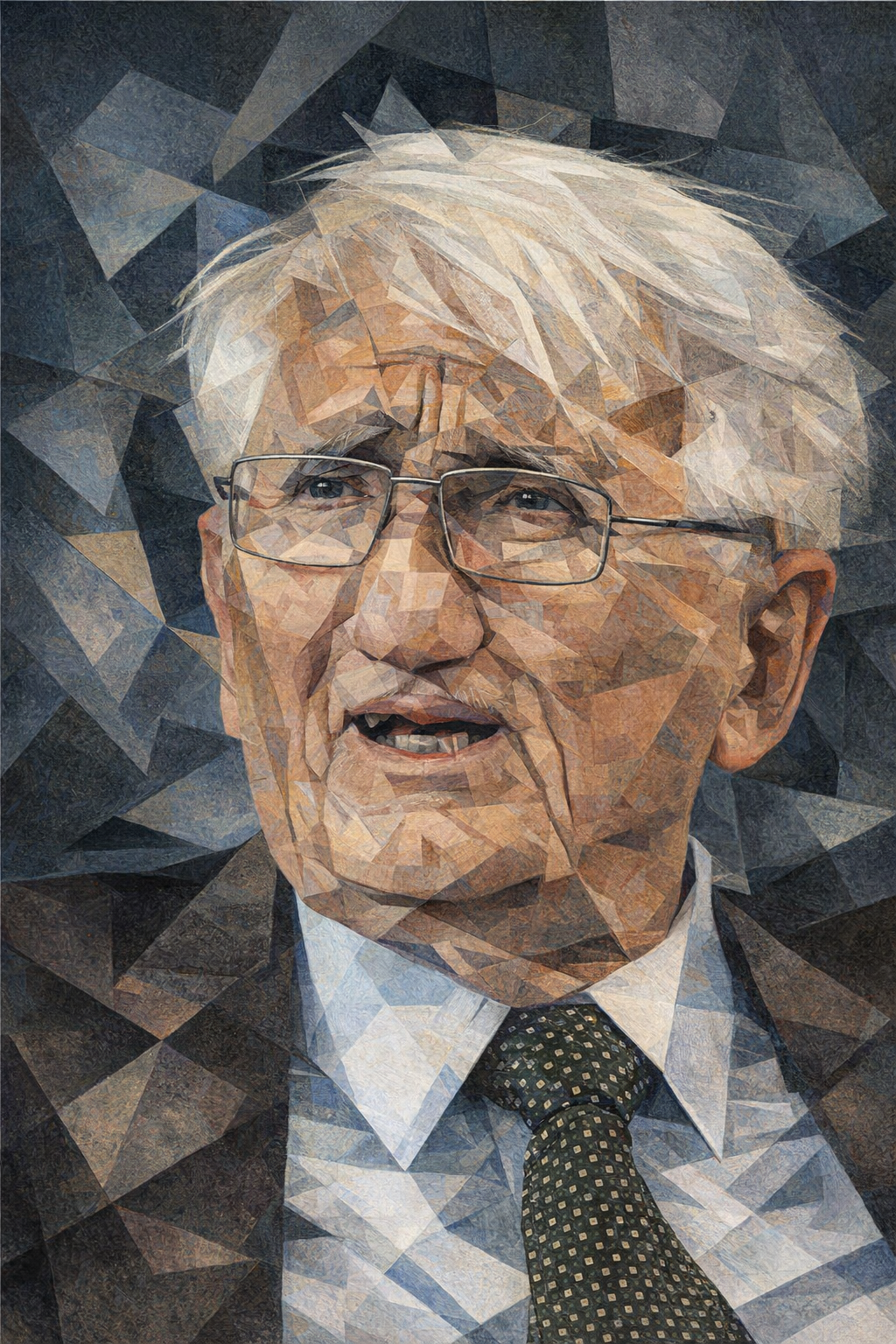
In what is recognised as his most significant work: “Theory of Communicative Action”, ed. Il Mulino, 1981, Habermas criticises modernity founded on ‘instrumental’ rationality—capable of discerning the connections between things, a tool not only of knowledge but also of domination and manipulation—and proposes a ‘communicative’ rationality founded on dialogue, inherent in intersubjectivity, tending towards understanding between free and thinking subjects, with the aim of understanding (Verständigung) between human beings. The communicative act or action of such communicative rationality must be characterised by truth, veracity and fairness. Communicative action establishes the ideal of justice in public, argumentative dialogue on matters of law and shared norms.
The institutional form of ‘deliberative’ democracy stems from this dialogical and procedural rationality. In a democracy, everyone’s rights must be recognised; everyone must be heard and understood. The common good arises in and from the process of rational communication, which prevails through argumentation rather than through violent and overbearing force.
Whilst we may appreciate dialogical rationality—with its consequent authentic and constructive communication—as opposed to instrumental rationality—with communication consisting of slogans and lacking the intersubjective dimension and the argumentative structure of public discourse, which opens the door to possible illiberal deviations—we must note that the concept of “justice” proposed by Habermas lacks value references that guarantee, beyond shared consensus, rights and norms. In the Christian tradition, however, we can find the metaphysical foundation and the truth-based status of “Justice”.
For Christians, “Justice” is a characteristic of God; it is founded on God. His action in the history of salvation is defined by His faithfulness to the Covenant made with Abraham, Isaac and Jacob, and brought to its definitive fulfilment in the Son, Jesus.
Pope Leo XIV, at the Inauguration of the Judicial Year of the Tribunal of the Vatican City State, affirmed that the Christian tradition has always regarded justice as “a fundamental virtue for the order of personal and communal life”. Recalling St Augustine and his statement “ordinata dilectio est iustitia”, he reiterates that the order of justice also flows from the order of love. St Thomas defines justice as the “constant and perpetual will to give to each person what is due to them” and maintains that justice is ordered towards the common good and is rooted in the truth of every person.
In light of these considerations, and thinking of the many wars that stain the earth with blood and cause the deaths of thousands of human beings, can we still believe that justice is possible? Are paths of dialogue leading to peace possible?
“But do not believe those who paint humanity as a lame beast and this world as a ball at the end. Do not believe those who paint everything in pitch black and blood. They do so because it is easy to do.
We’re just confused, believe me. But we feel. We still feel. We’re still capable of loving something.
We still feel compassion.
It’s up to you now; it’s your turn to wash away these scabs from the living bark.
There is splendour in everything. I have seen it. I see it even more now. There is splendour. Do not be afraid.”
(Mariangela Gualtieri).