A talk by Eleanna Guglielmi to the participants in JoMES 2026 – 16–25 September 2026, Busseto, Parma, Italy
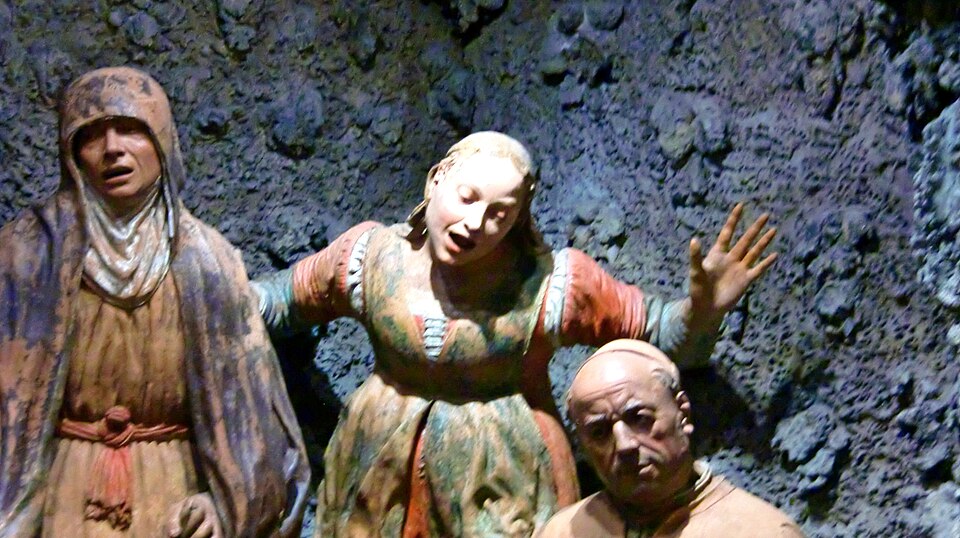
Guido Mazzoni, Compianto sul Cristo morto (detail), terracotta, 1476-77 ca., Chiesa di Santa Maria degli Angeli, Busseto (Parma), Italy
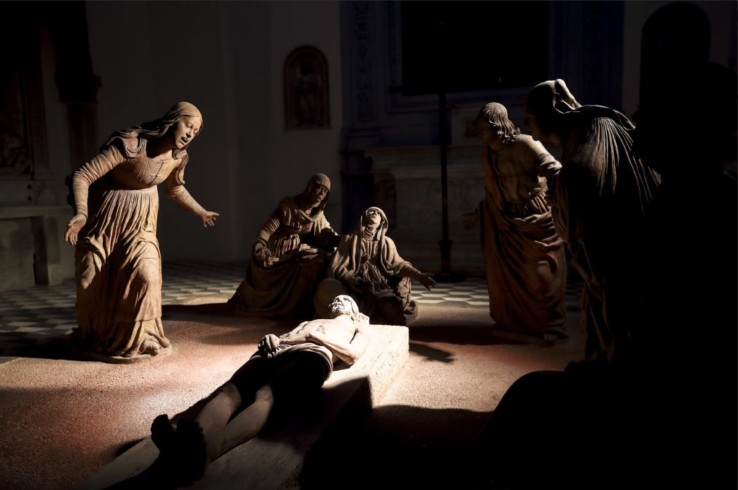
All around the “Compianto”.
Catch the gaze of whoever you like. Stand beneath that gaze. Is there someone who strikes you most, or in whom you most recognise yourselves?
Silence.
Well, here is the whole of humanity: the humanity in the classroom and the humanity outside it. With their tears, their grinding teeth, hands crying out to heaven, shaken eyes, bodies worn out by tension, by work, by the journey.
These days have been full of clues. Clues for carrying on, from now on, with a sense of conversion, and for moving from the classroom to the world. Or rather: for being in the classroom already with a sense of mission. Helping, serving, the other missions are already part of what you aspire to. And that is not to be taken for granted.
But how? There are no precepts. There is a way of being present, and from it comes a way of contemplating, of seeing. And then a modus procedendi, a way of proceeding. So here are the three “hows”.
- Like someone about to get engaged.
- Like someone about to become a father or a mother.
- Like an inconvenient witness.
And three examples, three men: C.S. Lewis, Bernardo De Angelis, Giovanni Guareschi.
One autumn evening in 1939, in the Anglican church of St Mary the Virgin in Oxford, C.S. Lewis speaks to students. The talk is Learning in War-Time, collected in The Weight of Glory. England has just declared war on Germany. Europe faces the possible end of its civilisation. And Lewis asks:
“Even if we are not interrupted by death or military service, why should we (indeed, how can we) continue to take an interest in these placid occupations when the lives of our friends and the liberties of Europe are in the balance? Is it not like fiddling while Rome burns?… The true tragedy of Nero must be not that he fiddled while the city was on fire but that he fiddled on the brink of hell… You must forgive me for the crude monosyllable. I know that many wiser and better Christians than I in these days do not like to mention heaven and hell even in a pulpit… Human life has always been lived on the edge of a precipice… Men are different. They propound mathematical theorems in beleaguered cities, conduct metaphysical arguments in condemned cells, make jokes on scaffolds, discuss the last new poem while advancing to the walls of Quebec, and comb their hair at Thermopylae… We can therefore pursue knowledge as such, and beauty, as such, in the sure confidence that by so doing we are either advancing to the vision of God ourselves or indirectly helping others to do so. Humility, no less than the appetite, encourages us to concentrate simply on the knowledge or the beauty, not too much concerning ourselves with their ultimate relevance to the vision of God.”
Hell has many names: mediocrity, half-measures, settling. It is a matter of salvation.
God makes no appetite in vain, says Lewis. The present is the only moment in which we can receive the grace of placing at the service of others whatever our desire has led us to so far.
But how?
1. Like those who are engaged
When we have a fiancée, everything is about conquest, waiting, preparation. So: the humanity around us, anyone at all. Let’s try to treat people as we would a bride-to-be. And already in the classroom.
There is a text it would be lovely to have as your guide: the Song of Songs. At one point the bridegroom says to the bride: “You have ravished my heart, my sister, my bride” (Song 4:9). Here the bridegroom calls the bride “sister”, which was normal at the time. It also means they are of the same lineage, the same stock.
We can only love those who are like us: you cannot love someone who is completely different from you. The bride is also a sister, because from the very beginning you sense that this is so. You sense this fraternity.
First “how”: the humanity around us, anyone at all, as a bride-to-be.
2. Like fathers and mothers
You’re grown up now, and fairly well put together. Perhaps we all feel a bit crooked, wrecks of war, survivors, without a clear place… but we could all be dads and mums. Some of us aunts, and grannies!
It’s true that you become a dad or a mum when you are one. But it’s also true that only those who seek will find, those who prepare. Socrates, or Plato speaking of him, said that the soul is a task. Whose soul? And what does task mean? My soul and your soul, other people’s, is a task. Task as in homework, an exercise: compito, deber, a duty.
Perhaps the best word to translate Socrates is mission. A task in the sense that I cannot escape it: something I give myself and, at the same time, am given. My soul, the soul of whoever is beside me, of the people who come to me, of the people I will find myself with: their soul is a task, it is a mission. It is something entrusted to me, to care for.
Second “how”: the soul of the other is entrusted to me, to care for.
3. Like inconvenient witnesses
Let’s look at the Compianto again. Who did you choose?
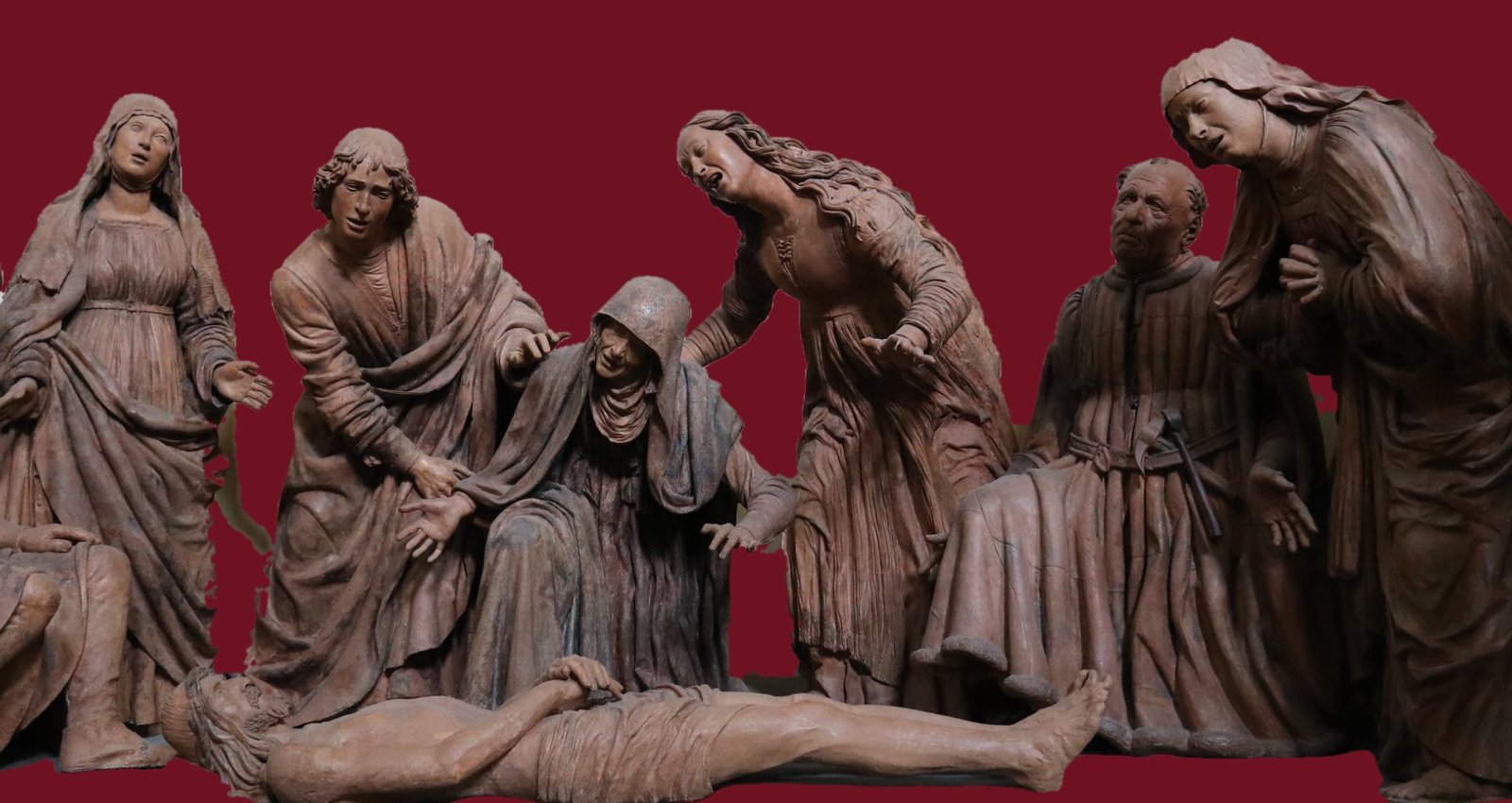
Guido Mazzoni, Compianto sul Cristo morto (detail), terracotta, 1477-79 ca., Church of San Giovanni Battista, Modena, Italy
You are him, another Christ, another him. And what does this Christ say?
As Giovanni Guareschi put it: “I won’t die, not even if they kill me.”
This body, here in front of us, is not a dead body, not a corpse: it is a body about to rise. To be among others as if they were dying, but with the resurrection inside them. Like the crucified, who will soon rise again.
“When Christ calls a man, he bids him come and die”, wrote Dietrich Bonhoeffer, the Lutheran theologian.
Let’s read a short story together (Bernardo De Angelis):
“Last night I opened the window. It was a clear night. The days before had been cold; it had rained. Up on the hills it had even snowed. And this is the middle of April. But yesterday, at last, had been a warm day. A lovely sun had cheered us. The night was still cold, because the sun had not had long enough to warm the earth right through, but it was clear. A beautiful night. And yet, the moment I opened the window, I don’t know why (had I heard something on the news? No, I think rather I had a friend’s possible illness on my mind), the endless suffering of the world came flooding into my mind. The dying, the grieving, the hungry, the sick, the children. I asked: My God, why don’t you put an end to all this? When will the end come? Isn’t there enough suffering yet? But as I was thinking these things, another thought made itself heard: suffering is not the measure by which the times are set.
So I said: are you waiting for the number of your saints to be complete? Of course, it must be so. There must be something like a sufficient amount of glory, to fill up the appointed measure. But how many saints are you still missing?
One, just one, the voice of my imagination replied.
I don’t know how many you are still missing. But what if I were that saint? Perhaps this too is among the things that must be believed.”
Right now, perhaps I feel as if I’ve been thrown into life without quite knowing why. Perhaps not thrown, but abandoned. Or in a state where I still don’t know where I fit: I do things, I’ve made choices. I know that many things have yet to be fulfilled, that I will still need many, many confirmations. But who brought you here? Who is handing you this mission? Who, one way or another, tends, stands behind, lies at the very bottom of every desire you have? Upright or not, crooked or shining.
Your Father, who is handing you this mission.
In front of this body, I ask myself: and should my form be any different from yours? The Father loves me as He has loved you.
Christ is simply the one who makes it possible for us to live it in a particular way. Who is bringing you into the world and handing you the world, the classroom, your classmates, these encounters, every other wonderful encounter you can have? Our Father.
Third “how”: to be among others as if they were dying, but with the resurrection inside them.
Some encounters are always re-encounters, because we are always missing a piece of fraternity.
There is always a brother missing at roll call.
The awareness to take back into the world, I think, is this: learning, really learning, to think of myself as a child, and of the other as a brother with whom to build a family: two who are born and reborn at every moment from the same Father. To think of us as two, three, four who were not born only of the will of the flesh or of blood, but who take this on, make it their own with responsibility, and seek to raise it up, to glorify it.
If there is a common good, it is this: fraternity. Fraternity holds all of this. It is not something merely natural, spontaneous.
We need to be ingenious in living like this, and to engineer tools as well: tracks, screwdrivers, toolboxes with which to become brothers and sisters wherever we are.
I am beginning to understand, by now,
that the world takes flesh in my body
as if it were yours.
Perhaps that is why at times
I struggle to fall asleep,
as if someone were always
knocking at my door.
— Bernardo De Angelis
How to cite this article
Eleanna Guglielmi PhD. (2026, November 11). Thinking in Order to Serve. Rielo Institute for Integral Development. https://riidblog.org/post/11-11-2026/